
Family and Group Conferences (FGCs) for Adults empower people to create their own plan for support.
Originally used in children and family services, FGCs are a growing area of adult social care. Research in Practice has worked in collaboration with the University of Birmingham and Community Catalysts to turn research findings, recordings and professional interviews into a comprehensive catalogue of learning resources. The new materials aim to support understanding, develop services and deliver training.
What is a Family and Group Conference for Adults?
A FGC is a meeting where a supportive network of family and friends come together to address the needs of an individual.
The approach is person-centred and can be used in health and social care settings. FGCs bring together a person who has care and support needs with the people in their network. This can be family, friends, and anyone else who loves and supports them. Everyone in the FGC is there because the person wants them to be and the meeting is always voluntary.
How does a FGC work?
Every FGC has a trained coordinator but the overall meeting is led by the individual. They can invite whoever they like from family and friends, through to social workers and health providers – whatever feels supportive. The meeting can be used for various circumstances including end of life care, safeguarding, preparation for adulthood, behaviours such as hoarding and self-neglect, and homeless prevention.
Before the meeting takes place, the coordinator will support the person to write down what they would like to discuss. The meeting will usually take place in a comfortable environment and not necessarily in a formal setting. During the meeting a plan will be agreed with all involved.
Once the meeting has happened the coordinator continues to work with everyone to plan what is needed going forwards. A review will then take place but only if it is supportive.
The below infographic explains the process.
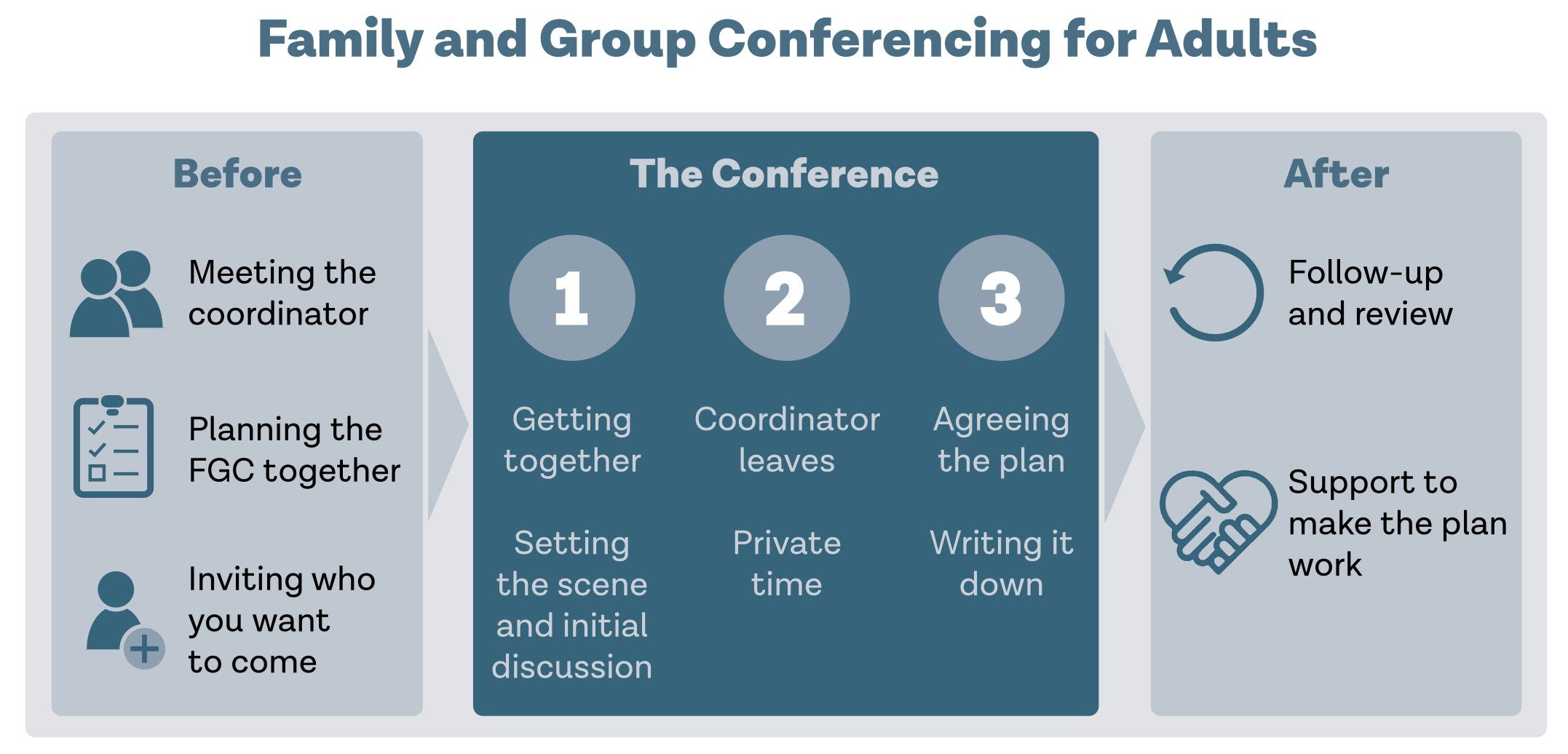
How to develop services for adults
To develop effective FGC services, collaboration is essential. The approach promotes independence and recovery by ensuring support is person-centred and inclusive. It is important to maintain people’s wider networks and a desire to achieve meaningful cooperation.
The core elements of good practice is set out in the FGC 14 Key Standards and Guidance. The standards were drawn up through enhanced consultation and are designed to inform the commissioning and delivery of FGC services. They provide a resource for critical reflection, and for auditing and developing practice.
They may be used as a framework for evaluation and in peer challenge, supervision or review. The below graphic outlines the standards which are - independence of the coordinator, initial training, preparing for uncertainty, explaining the process, flexibility, offering an advocate, supporting engagement, information sharing, venue, connecting, setting the tone, culture of learning, private time and review.
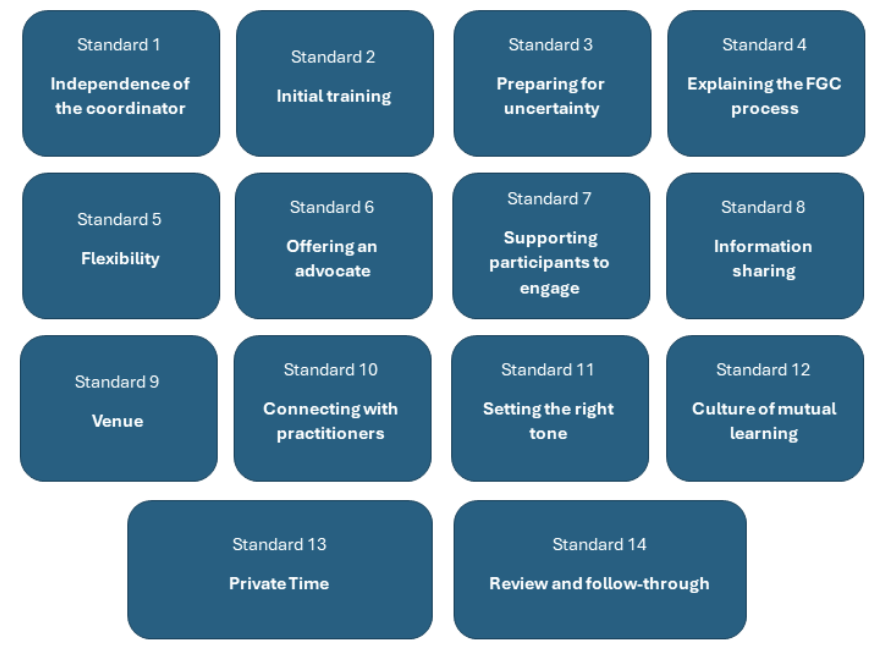
Delivering a FGC
The role of the coordinator is key to delivering an effective FGC so essential training by services is required. They support everyone to get the best out of it by explaining the process to participants, gathering relevant information, and ensuring the format is informal and flexible enough to best fit people’s preferences.
They are not responsible for what goes into the plan - but can enable its implementation, and they should not normally have any other role in relation to the central person and their network.
Services should provide ongoing support and continuing professional development for coordinators. Developing training and session plans that are shaped to reflect local contexts and the characteristics of the service landscape can be beneficial.
Experience of effective FGCs
An effective FGC shifts the focus away from professionals and towards the value that others bring. People with lived experience of FGCs have expressed that when conducted well they can:
- Offer choice and control – but with support.
- Get important people together.
- Be person-centered and adaptable.
- Make important plans but ensure they are not set in stone.
- Have long-term impact.
The model has been developed and commissioned in areas including Camden, Essex and Waltham Forest who have all reported good outcomes from using it.
The new resources build on these experiences to support areas to develop and commission FGCs. They are organised into three sections that explain:
- What a FGC is and how it empowers people to create their own plan for support.
- What is important to consider when commissioning or developing new FGC services.
- The ingredients of effective practice.
Including people who matter such as family members, friends, neighbours, members of faith communities, and other familiar faces means we can produce better outcomes.
