
Intersectional experiences around exploitation
Part of Adult exploitation suite of linked resources.
Exploring some of the experiences which can interconnect and expose people to exploitation.
We outline some of the experiences which can expose people to increased risk. Exploitation can be compounded by intersecting experiences, interwoven with systems of power, oppression and social inequalities. Perpetrators can capitalise upon social disadvantages to control the people they exploit.
Intersectionality
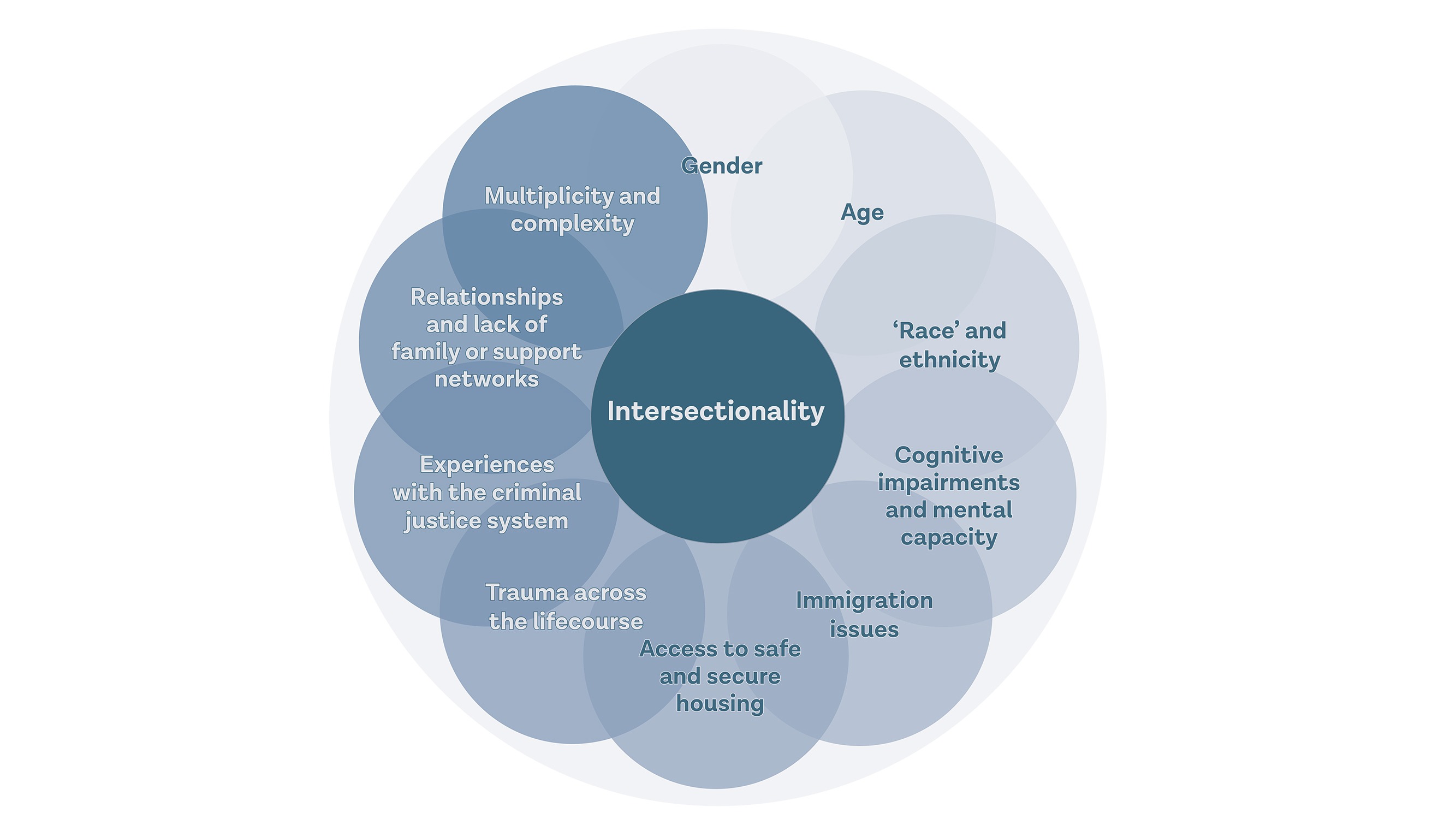
The concept of intersectionality was first described by Crenshaw (1989) and refers to the interaction between multiple forms of oppression. Understanding how the interplay of people's individual experiences can mean they face multiple, often compounding, forms of discrimination is essential when considering person-centred care and support responses.
The Equity Change Project by Research in Practice, provides resources on using intersectionality to challenge oppression.
Intersectional definitions
Gender can shape experiences of abuse and exploitation. For example:
-
72% of potential adult victims referred through the UK’s National Referral Mechanism (NRM) in 2024 were recorded as male, and 28% as female.
-
2024 NRM data indicates that males most often reported labour exploitation.
-
Evidence from official recording and survivor-focused research indicates that females are particularly exposed to sexual exploitation.
-
Whilst data collection is inconsistent, there is also growing recognition of the sexual exploitation of transgender individuals.
Despite trends, it is important to remember that assumptions based upon gender may risk overlooking individuals who don’t fit dominant paradigms. Research indicates that females may be targeted for some forms of criminal exploitation as they are less likely to be identified or intercepted by the authorities. Societal misperceptions around the vulnerability and possible victimhood of men can leave many unidentified and unassisted. Professional curiosity is therefore essential when considering gender in exploitation.
Whilst responding to the exploitation of adults typically indicates people over 18 years of age, it can be helpful to think about experiences across a person’s whole lifecourse. This can enable a more subtle understanding of their context, choices and options.
Services are often delineated by age categories, with children’s services ending and adults’ beginning at 18. However, people’s life experiences are rarely so distinct. Withdrawing services based upon age alone can leave may well continue, with both human and economic costs in the longer term.
A binary framing of childhood and adulthood can also reinforce associated perceptions around vulnerability and culpability around exploitation. The support offered to individuals can change as they encounter children’s, young people’s and adults’ services, with a perception amongst some that ‘innocence recedes with each passing year’. However, whilst a person legally becomes an adult at 18, it may be necessary to take a more nuanced understanding of their individual development and maturation.
Young people’s experiences around exploitation can be complex. They may experience both being exploited and also exploiting others, which further challenges simplistic understandings. Young people’s individual development and social context can shape their actions, including involvement in criminal activities.
Thinking in terms of the life course can enable a more joined-up response, explicitly recognising the individual’s past, present and potential experiences. In this context, Transitional Safeguarding offers an approach which supports individuals to navigate risk and safety throughout their unique journey into adulthood.
Further Reading:
- Research in Practice -Transitional Safeguarding briefing for sector leaders: Strategic Briefing (2025).
- Research in Practice - Bridging the Gap: Transitional Safeguarding and the role of social work with adults – Knowledge Briefing (2021).
Racism and discrimination exacerbate many of the experiences which can increase a person’s susceptibility to being exploited. It is essential to consider how structural inequalities may influence a person’s options and choices. For example:
-
Poverty – Data indicates a pattern in which poverty is higher among Black and minoritised ethnic groups than among the white majority population. Whilst this broad picture does not reflect the nuanced experiences of different ethnic groups, it highlights the disproportionate impact of economic inequalities. These in turn can increase susceptibility to exploitation.
-
Homelessness – Research also demonstrates that people from Black and minoritised ethnic communities experience disproportionate levels of homelessness. As detailed below, homelessness is closely associated with the exploitation of adults.
-
Experience with the Criminal Justice System – People from Black and minoritised ethnic communities and foreign nationals are significantly overrepresented in English prisons. Criminal records and imprisonment can further marginalise people and reduce their opportunities for support.
-
Mental health – People from minoritised ethnic groups in the UK report ‘poorer mental health and access to mental healthcare, and more negative experiences and outcomes compared to the majority white British group’. Again, this can increase the vulnerabilities in a person’s life.
It is essential to remember that ‘inequality and marginalisation can be both a driver for, and a consequence of, exploitation… and that professional efforts can inadvertently reinforce inequity’. Responses to concerns about safeguarding and exploitation amongst Black and Global Majority communities have been reported to have unintended consequences. For example, research documents how the conceptualisation of ‘county lines’ has led to the overpolicing and underprotection of young Black men.
It is therefore critical to ensure that issues are conceptualised accurately and appropriately. Social care and advocacy services can support this through ‘meaningful, ongoing, inclusive engagement with communities’ to ‘ensure that individual rights are protected through co-produced solutions’.
Cultural humility is essential when seeking to understand and respond to the exploitation of adults from marginalised ethnic groups. Anti-racist practice is required at all levels of the system.
The potential impacts of prior trauma require sensitive consideration in relation to adult exploitation. It is essential to remember that people from any background can be targeted for exploitation, and to avoid deterministic expectations of children and young people who grow up in challenging circumstances. However, experiences of adversity in childhood can make some adolescents particularly vulnerable to harm, and the effects of this can persist into adulthood.
Such difficulties can be exploited by perpetrators, who identify individuals who are easier to control. Adults experiencing criminal exploitation commonly report having been ‘recruited’ as children. Whilst in childhood, exploitation is increasingly recognised as such, in adulthood the individual may be held responsible for their situation. A trauma-attuned approach can support practitioners to understand and respond to adult exploitation in a more nuanced way.
Further reading:
- Tackling Child Exploitation: Practice Principles Research Summary provides more information on recognising and responding to trauma in relation to exploitation.
Substance use can be both a mode of exploitation and a means of relief in intolerable circumstances. Substances may temporarily reduce individuals’ distress, whilst simultaneously creating vulnerabilities which can be further exploited.
People with existing addictions may be targeted for exploitation such as county lines or so-called ‘cuckooing’ (see 'Access to safe and secure housing' below). An individual’s dependence on substances creates a power imbalance which can be manipulated to force them into criminal activity.
Coerced drug and alcohol use can also be a feature of abusive relationships and sexual exploitation. A person who is forced into intoxication or addiction can be easier to control.
Substance use is often just one factor alongside other vulnerabilities, including social exclusion, homelessness and poverty, creating interconnected risks and challenges.
Exploitation is a global issue, and there are additional challenges for people experiencing exploitation in the international context.
-
People who have been trafficked: Individuals trafficked into the UK often have their documents taken from them by the traffickers (Home Office, 2024). Without paperwork or citizenship, people have limited options and agency.
-
People seeking asylum: The process of seeking asylum and receiving a decision on refugee status can also create vulnerabilities around housing, finance, isolation and lack of information/support. Perpetrators can capitalise upon this to exploit people’s situations.
Further information on this subject is provided within the 'Housing' item.
Mistrust of authorities, fear of being deported / imprisoned, fear for families at home, lack of knowledge about available support, language barriers and feelings of shame may all make it more difficult for individuals to seek support. It is therefore important for practitioners to consider how an individual’s immigration status might shape their exposure to exploitation, and to work with them to identify appropriate support options.
There is a significant relationship between housing and exploitation. Some examples of how this can be experienced are outlined below:
- Street homelessness: People experiencing homelessness have been targeted for exploitation and people can also be forced into homelessness as a result of being exploited. Higher rates of substance use by people who are street homeless can increase the intersecting risks of exploitation further.
- Precarious housing: Precarious housing also leaves people more susceptible to abuse. People with insecure housing may engage in ‘survival sex’, in order to secure accommodation, other basic living needs or substances.
-
- The term ‘survival sex’ refers to the exchange of sexual activity for basic subsistence needs such as food, safety, shelter, alcohol/other substances and so on. The term reflects the structural inequalities and constraints which can influence individuals’ options and actions.
- Property exploitation: People may also be targeted for property exploitation, also known as ‘cuckooing’ or home invasion. Perpetrators take over the premises, often to store or deal drugs at lower risk to themselves. If this abuse is not recognised, the victimised tenant may be held responsible for any criminal or anti-social activity occurring in their home. If a tenant is evicted or forced out, they may be deemed intentionally homeless – which can negatively affect future housing options.
- Accommodation-based enslavement: A person’s living arrangements may be directly tied to conditions of enslavement, enabling perpetrators to exert further control over their situation. This can be seen in domestic servitude and, for example, cannabis farms.
These examples underscore the need for safe accommodation for people seeking to escape exploitation of all forms. However, profound limitations in housing options curtail this. Where provisions are not suitable or available, people often return to homelessness and the associated risks of re-exploitation.
There is an association between victimisation and criminality: people experiencing exploitation may have experienced criminal activity as victim, perpetrator and/or witness. Displacement, destitution and desperation can leave people with ‘near-impossible choices’, leading some victims of exploitation to commit offences.
-
Criminal records: Criminal records and custodial sentences may result from acts of survival or coercion during exploitation. Having a criminal record itself creates further barriers to future education and employment.
-
Imprisonment: Research highlights ‘a high likelihood of unidentified survivors of modern slavery’ in the UK’s prison population. Without recognition, it is impossible for these individuals to be offered appropriate protection and support – and the prison environment itself can be detrimental to recovery.
Access to care, support and safety: Being criminalised and imprisoned can further marginalise people who are in need of care, support and safety. Custodial sentences often disrupt people’s accommodation, relationships and income. If people are exposed to homelessness, stigma and economic vulnerability upon release, their risk of re-exploitation is high.
Research indicates a link between cognitive impairments and risk of exploitation. Cognitive impairments include developmental and acquired conditions. They can be experienced by people living with a learning disability, dementia, brain injury, autism, ADHD, functional mental health disorders and substance misuse. Although these are very different conditions, their impact upon people’s social functioning and relationships can lead to similar vulnerabilities around exploitation.
-
Mental capacity: Consideration and assessment of mental capacity may be required in relation to exploitation. Repeat assessments may be necessary to identify any fluctuation in capacity, and whether factors like substance use, medication and concurrent illnesses influence decision-making over time. When individuals are apparently making capacitous decisions or acting upon them in relation to exploitation, it is also essential to consider if and how coercion may be influencing this.
-
Undiagnosed concerns: It is also important to recognise that a lack of diagnosis of cognitive impairment could equally increase someone’s vulnerability, as this can reduce awareness of the risk factors. Practitioners may need to consider undiagnosed health issues and unrecognised care and support needs, where concerns about exploitation arise.
Experiences of exploitation can themselves lead to anxiety, depression, post-traumatic stress, shame and guilt. Cognitive impairments can interact with social isolation, poverty and homelessness thereby compounding a person’s susceptibility to exploitation and abuse.
Loneliness, isolation and loss of relationships are common experiences reported by adults who have experienced exploitation.
Lack of protective family or support networks:
- The absence of a supportive family network has been identified as a common experience across all forms of exploitation. Similar findings are mirrored in research involving adults living with cognitive impairments, young people, women and men.
- Traumatic losses which shaped exposure to exploitation included the early death of parents and separation from children through care proceedings. Subsequent feelings of shame about the experiences of exploitation can isolate people further.
Influence of harmful relationships:
- Where positive relationships and support networks are absent, unhealthy and abusive alternatives often emerge. Perpetrators may appear to offer friendship or connection where people are otherwise isolated, generating a sense of loyalty and even empathy from the victim.
- For example, many women who were sexually exploited also reported abusive and violent intimate partner relationships. Exploitation of adults with cognitive impairments often occurs within social networks and subcultures which normalise abuse. The social context of abuse and harm is especially relevant for young adults, along with the influence of peer-to-peer.
Coercion and control:
- Coercive control can be a significant influence in the exploitation of adults. Individuals are often exposed to dangerous and/or criminal activity through lack of real choice in their situation. It is essential to consider the driving forces behind a person’s apparent decisions and actions.
- Whilst originally defined in relation to intimate partner or family relationships, there are similarities in how coercive control is exerted by perpetrators of exploitation, where relationships may be constructed around ‘friendship’, intimacy, work and so on.
- Actions within the definition of Coercive or Controlling Behaviour (CCB) are wide-ranging, and can include: threats and intimidation, restrictions and deprivation, physical violence, digital/technological abuse, monitoring and manipulation, psychological and emotional abuse.
It is essential to consider how interpersonal contexts and relationships might influence a person’s exposure to exploitation. Social vulnerabilities may be capitalised upon by exploitative individuals or groups.
It is clear that individuals often face a combination of interacting factors which increase the risk of exploitation. Such interconnected experiences require a highly integrated system of support. Taking time to identify the interplay of people’s experiences is essential to understanding the structural dynamics and lived realities of exploitation – and then to offering effective responses.
The Making Every Adult Matter (MEAM) Approach may support this. MEAM recognises how people’s personal, social and political identities intersect with associated discriminations, to create unique experiences of multiple disadvantage. MEAM Approach recommends that support ‘must be long-term and relational; follow people on their journey across services, places and transition points; be built on mutual trust; and not be time-limited'.
Reflective questions
-
How are the intersectional factors around exploitation identified and understood in your context?
-
What steps can you take to help overcome inequalities in access to support?
-
Within your role, how can you promote holistic responses to the exploitation of adults?
Professional Standards
PQS:KSS - Safeguarding | Assuring good social work practice and development | Promoting and supporting critical analysis and decision-making
CQC - Responsive | Safe
RCOT - Health and safety
Adult exploitation
Materials across three main sections, providing an introduction to the exploitation of adults, particularly those who experience multiple needs and exclusions.