
Completing, sharing, celebrating
Part of The mark of co-production. Select the quick links below to explore the key sections of this page.
Introduction
When goals are achieved through co-production (even if they’re not exactly what was planned!) they should be widely shared and celebrated. This is important not only to highlight the project’s goals but also to share the experience of co-production itself.
Although co-production projects might end, it’s important not to see co-production itself as having an end. Try to see the beginnings at this stage, too – what other services, policies, and projects could be next for the co-production approach?
As highlighted in the briefing on co-production and strengths-based practice, research has found slow take-up of co-production. While organisations may be open to co-production in principle, they may be reluctant to invest scarce funding in what is often seen as a creative and unpredictable approach. Therefore, by seeking out opportunities to share a co-production project’s successes and challenges, co-production is de-mystified, and others are encouraged.
Co-production has been painfully slow. Not even frustratingly slow, but painfully slow. I find it hard to really believe that, after years of talking about it, it’s still not happening. […] I do understand that local authorities lack the capacity, that they have to do things quickly, which is why a survey is much easier to send out. But really, it is so much better to get at the heart, and do good work with communities.
For each mark of co-production, consider together:
-
What does this mean for our project?
-
What ladders do we have?
-
What snakes might lay in wait for us?
-
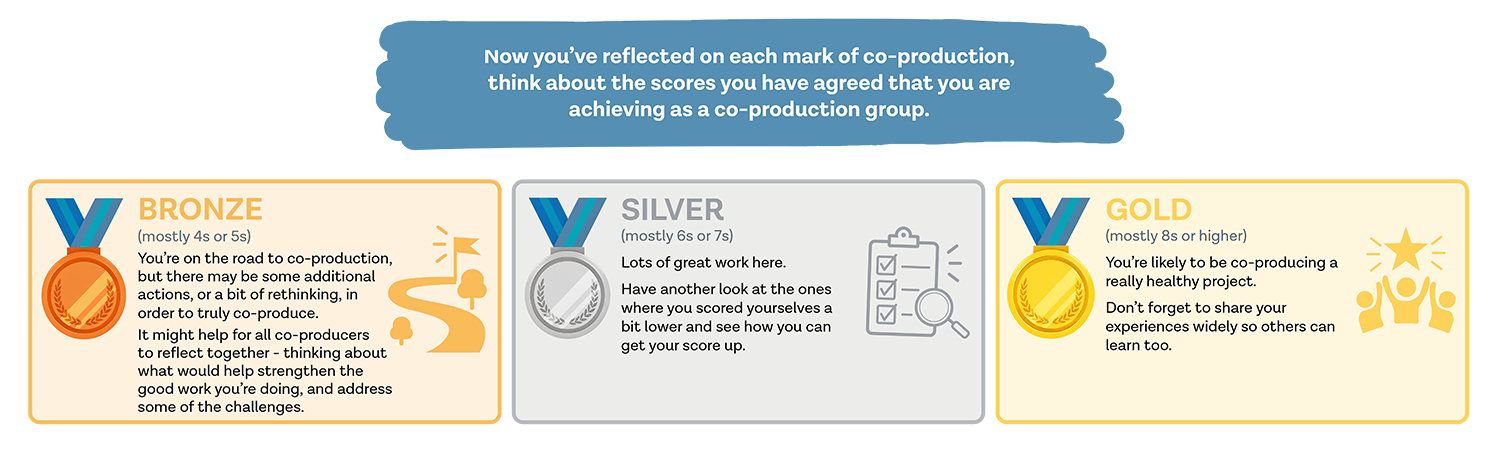
How far are we currently achieving this? (You might find it helpful for all co-producers to agree a score between 1 and 10 – you can then reflect on these scores at the end).
Then, add in any other marks of your own.
Don’t miss looking at the Lake of ideas - what ideas might be relevant at other stages of your co-production project?
 The times when I’ve been most annoyed is when someone’s asked me something and I’ve shared, then there’s nothing. Tumbleweed.
 This is one of those things that’s definitely not about money! However small the project is, everyone can say thank you at the end.
 There were some projects I’ve done and to be honest, I don’t even know if they’ve finished. You’ve given them a very valuable personal insight, then there’s nothing. They just take and don’t even share the output with you.
 I like it when people stay in touch and share anything else that’s happened as a result of the project. Sometimes you work with early-career researchers, and if our work contributes to them getting their PhD funding, I want to know that! That person has achieved their ambitions, and you’ve been a part of that.
 It’s good to put something in at the start of an update email, saying it’s not necessary to read it if you don’t have time, so people can decide for themselves if they want to stay updated once a project is over.
Co-producers with lived experience may not describe things according to an official style guide or use professional jargon. One of the reasons co-production is so valuable is because it does just this – bringing in voices that have traditionally been marginalised. Celebrate that authenticity, and think about how any clashes with a more professional ‘sheen’ will be managed.
We might have a co-produced project, but when marketing, or comms, get involved they have a certain way of doing things. It can be PR-friendly, and dilute the original meaning a bit.
I think it always needs to be framed as ‘this is the voice of the participants’. We don’t have to toe the company line and that’s a strength. If it’s critical about something, for example, then it’s clear where that criticism is coming from.
When the language is softened by senior decision-makers, that’s power reasserting itself.
(Thanks to Isaac Samuels for this example.)
This is an opportunity for the professionals on the project to use their skills and influence. It's important to take ownership of the project and be strong at this stage, to say 'this is exactly what it means and what we need to say'.
Be open about the challenges - this helps others too
Being too idealistic about co-production isn’t helpful. While positivity and belief in co-production is important, sugar-coating difficulties means that others – who may not have direct experience of co-production – will be less prepared if similar challenges emerge for them.
Demystify the process! Try to be open and honest so others can learn.
The celebration that really jumps out for me, because it was co-designed, is the Dementia Mapping one. We produced the book of poetry and spent the afternoon doing collaging.
In some cases, it’s like 'you do the speaking, you’re good at it.' But I don’t want to do it.
We had a nice online event. Everyone who was part of the project could come, and speak if they wanted to, but it was a free choice. Loads of people did choose to speak, just five or so minutes about their experience of the project.
Celebrations and thanks don’t have to be an event. It might be access to journals or articles. I had something where they once gave us a limited number of articles, and that was great.
We all talked about ‘how do we communicate this’ and I said, well, why don’t we make a video? It was shared through the voices of people rather than a PowerPoint.
Go outside the usual mechanisms to share learning
While established professional forums and events are useful to share learning around co-production and the findings of a project, try not to limit thinking to them. What channels do lived experience co-producers have? Often, people are involved in more than one co-production project and have valuable personal networks.
I know people who have done so many projects over the years. Their networks are vast, and they’re happy to share.
Keep people’s details on file (if they want)
At the end of a project, it’s important to get permission to hold on to people’s details – and check if they wish to be contacted in the future about any new co-production projects or other chances to get involved.
'Build a network of people with lived experience. That way, you’re not starting from scratch with every new project. It’s important to get in fresh voices (from both the lived experience and professional perspectives) but, this way, you’re starting from a positive baseline.'
It might be a certificate. A lot of people like these, because you can put them on LinkedIn or include them on your CV.
Saying you’d be happy to act as a reference for people in applying for jobs can be very helpful.
Reflect on your own experiences
Spend some time thinking about your own personal challenges and achievements in co-production. What have you learned about co-production – and about yourself?
'Being a co-producer profoundly changed my whole attitude. There were lots of things I didn’t expect from it, but all – even the slower, more difficult, more emotionally challenging bits – were necessary to making it work in the end. Now, when I’m looking at any project, I always ask the question – how can this be co-produced?'

The mark of co-production
A digital tool to help anyone interested in planning, running, or evaluating a co-production project.