
Introduction to co-production
Part of The mark of co-production. Select the quick links below to explore the key sections of this page.
What is co-production?
Co-production is when people come together as equals to make decisions or create services that work for them all. This always includes people who draw on care and support and/or carers, usually alongside people who work in care and support. It is based on the idea that those who draw upon care and support are the best placed to decide how it should work.
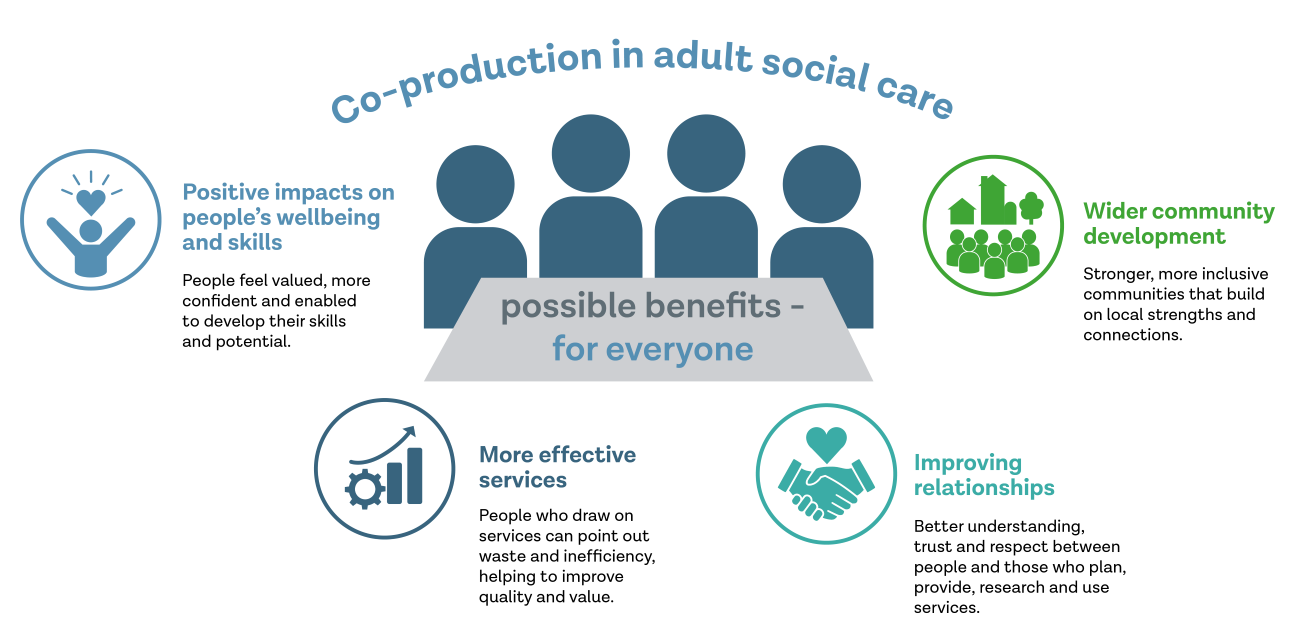
Co-production in adult social care has a number of possible benefits - for everyone.
Why is co-production so important?
In the following video Jenny Hurst (one of this tool's authors) shares insights into how vital co-production is in adult social care.
Length: 2 minutes.
For more information about the research into co-production see the Co-production and strengths-based practice: Leaders' Briefing (2020).
I think co-production is really important because it brings people together in the room to solve issues that might have been identified or haven't yet been identified.
Co-production is a great way to redress the power imbalance that there is, and I think part of that is because you have different sets of people with different priorities or different pressures.
So a council officer will have the pressure of their key performance indicators and knowing that the managers are saying to them ‘Look, be careful of the budgets’ and you have disabled people or other stakeholders who are looking at things from a different perspective, who don't understand those pressures.
So with people coming together, it helps a sort of joint understanding of where people's perspectives are. What's important to people, and that really helps people to sort of come together and understand where demands might be too high or where to push or to come up with solutions or compromises based on what they've jointly heard is, you know, redressing the power imbalance of ‘We are the the council’ or the public body. And we know best and ‘You, the stakeholders / residents are just demanding too much. And you don't understand.’ Well of course you don't understand, because those... there haven't been those conversations.
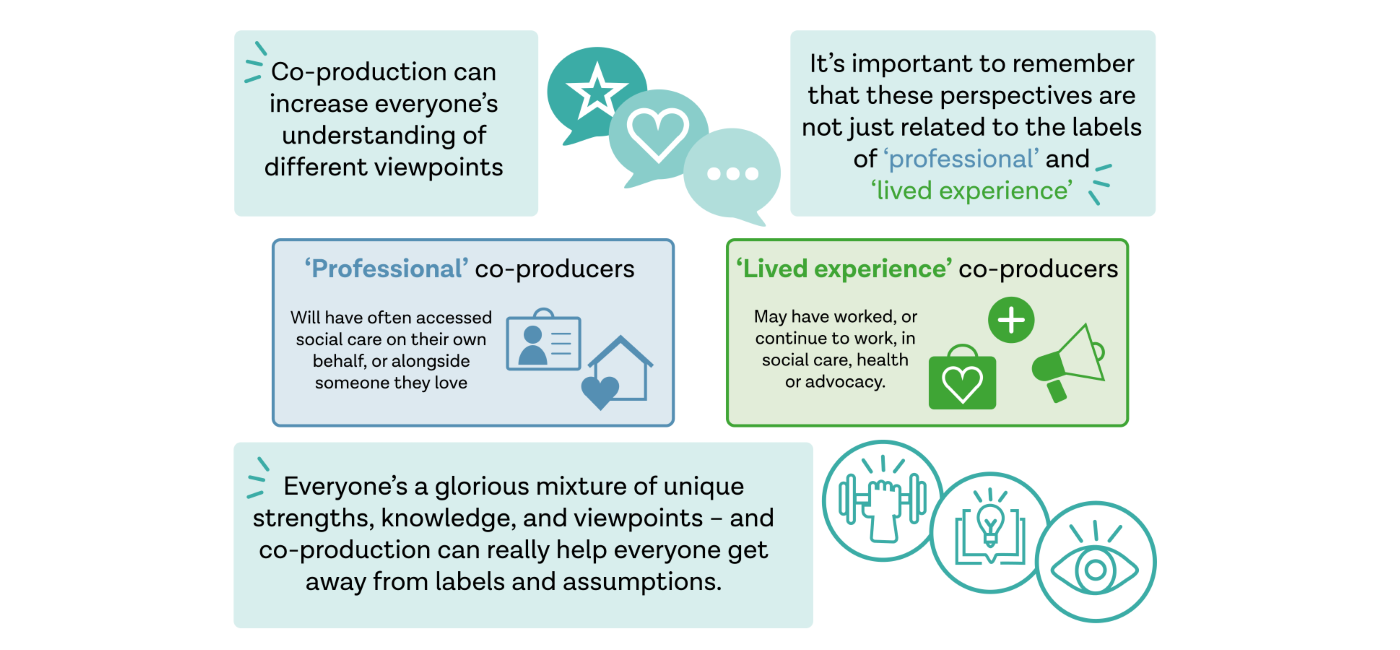
And that's where co-production really helps. It's coming together as equals. Everyone has important things to share and to put into the mix.
So coming together as equals, looking at different ways of solving problems and then thinking ‘How can we pick the main difficulties or the main solutions that we need to put into place, and come up with innovative ideas of doing that?’ that neither party would have thought of on their own.
Professional and lived experience
The ladder of co-production
Co-production is commonly shown as part of a ‘ladder’ of participation. The ladder was created in 1969 by the US government worker, Sherry Arnstein.
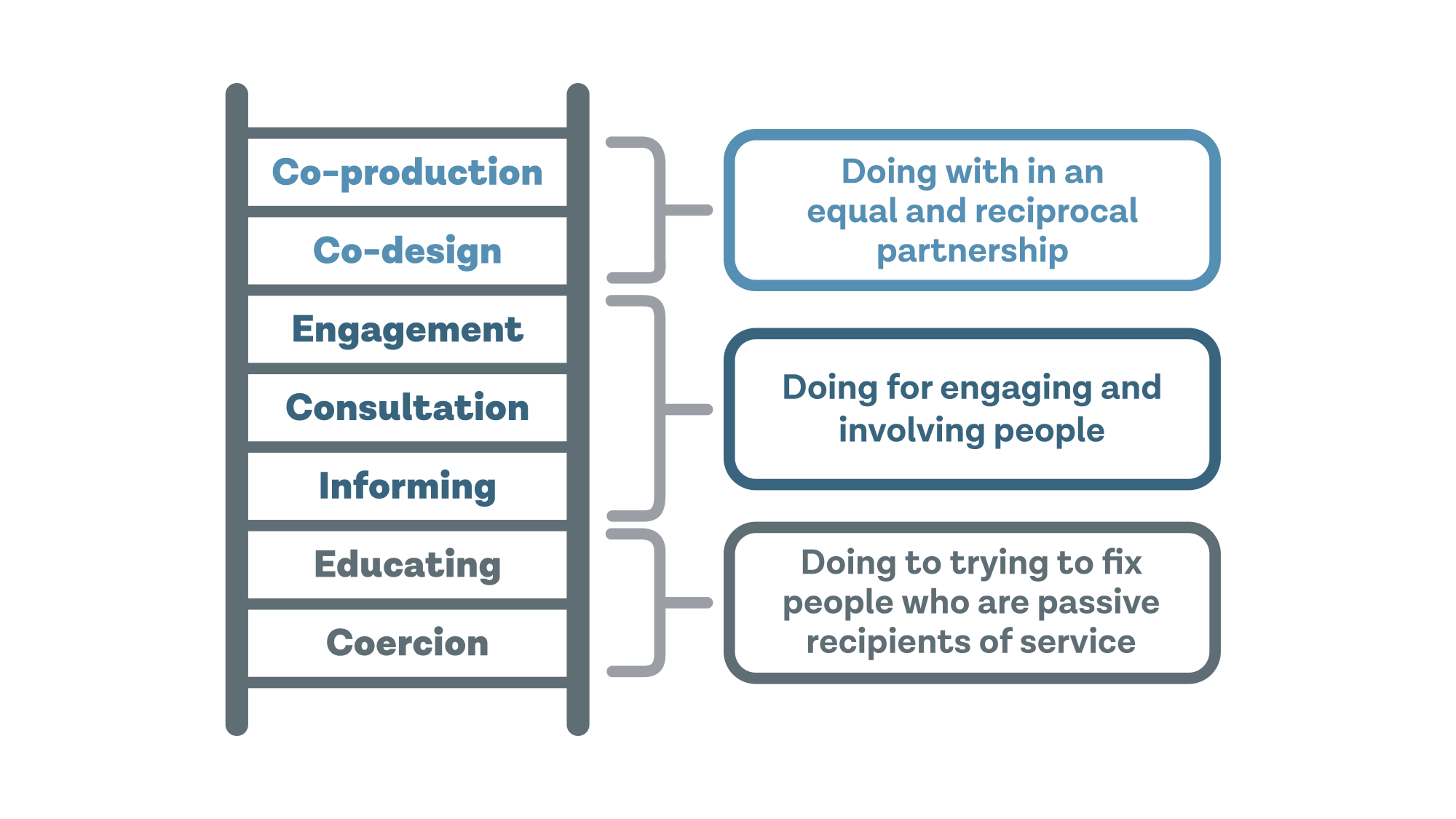
Arnstein used the ladder to illustrate different levels of participation she had observed in her work. She wanted to make the point that “there is a critical difference between going through the empty ritual of participation and having the real power needed to affect the outcome of the process”.
Arnstein didn’t mean that other types of participation aside from co-production were pointless. Instead, she was referring to things that had been called ‘participation’ but didn’t change decisions or outcomes. Some examples she identified were of people being consulted after key decisions were made, or when their input could not realistically change outcomes.
While highly influential, co-production – shown at the top of Arnstein’s ladder – is not the only method of participation. Different approaches may suit different purposes. One critique of the ladder is that it implies a hierarchical approach that overlooks other forms of participation. It’s also been suggested that the ladder doesn’t always reflect the relational, evolving reality of participation.
As written by Osborne et al. in 2016, "Co-productive elements are more of a continuum than a steady state." For instance, in some projects, organisations may be heavily bound by legal, financial or timescale factors. This may mean that the ‘engagement’ or ‘consultation’ rungs of the ladder are more appropriate to aim for.
Arnstein's central argument is that participation is not simply about involvement, but about power — specifically, the redistribution of power so that those who are often excluded can influence decisions, shape outcomes, and share in the benefits. This means that the ladder is helpful not just for its top rung of co-production – it can support everyone to reflect on what’s right for a particular project.
In this resource we are particularly thinking about how we transform adult social care into a system that works better for people. This means we are focusing specifically on co-production. Co-production says that the project will ‘do with’ and not ‘do to’ people. It also says that it’s not only the end result that’s important, but also the process itself. The authors of this tool agree that co-production promotes sharing power as equals and helps to pro-actively guard against professional voices leading a project.
Talking about co-production
In this excerpt from a full podcast on co-production, Anna Severwright (of Social Care Future, a people-powered organisation) and Jeanette Sutton (one of this tool’s authors) discuss power-sharing and taking a “leap of faith” in co-production.
Anna: I think there's often a lot of lip service paid to, like, the word co-production or lived experience or sometimes people might have a separate co-production group over there that they go to for a bit of advice and to check things, sound things out. I think real co-production where actually, like, power is shared is… I think it's often quite hard to do but I also think people are often quite scared of it because it involves them letting go of some of that control that they've had for a long time.
Jeanette: Yes, for sure.
Anna: Yes, and not knowing where that piece of work is going to go because the whole idea is that actually you, as a professional, or that organisation, or whatever it is, don't have all the answers. It's a bringing together of minds and ideas and that actually, at the end, I think you get something better and more interesting and more real and grounded in reality and practical but you, sort of, have to have that leap of faith, I think. People are often so used to the ways that things have always happened and we do see some progress. So one of the things we did at one point was ask speakers to take a pledge that they wouldn't speak at events if there was nobody with lived experience on the panel speaking. You know, just today I've had a couple of e-mails through about events that are happening in the next few weeks where there's a panel of four or five experts on social care, not one of them with lived experience. Even when I am on the panel, or someone like me is on the panel, we're, like, still outnumbered and we can be just seen as like… well, we're a nice to have but we're not an expert. I think it's trying to squash that idea of what is expertise, what is knowledge, what is skills. There are a lot of assumptions and, dare I say it, sort of, ableism and ageism and you know it was a lot of work went into this. It takes time. It's not necessarily an easier process but that actually it's the right way to do stuff and I think, you know, you get a much richer result at the end.
Jeanette: Yes. I think that point about power and control is actually a really, really key one and a lot of organisations, whatever they are, whether they're third sector, whether they're local authorities, there is like, 'Well, we need to have these outputs, we need to have these outcomes, we need to know where this is going, how much it's going to cost, what kind of time it's going to take up,' and, yes, you can do that to a certain extent with co-production but if you're sticking too rigidly to them, it's likely that you're not going to be co-producing something. You won't be co-producing those outcomes, they weren't emerge as you go on and there won't be the scope to change things, as new things come up. It, kind of, for me, would inhibit the open-mindedness that's really necessary for it. That leap of faith, especially at the beginning, is where you might not see things for a while. It's relationships, trust, which was something that I found to be really, really important in this project.
Throughout this resource we use the idea of snakes-and-ladders, like in the familiar board game, to guide you through your journey of co-production. All the examples we share, whether snake, ladder, or observation, come from real-life experiences.
 Snakes represent common misunderstandings or actions that can undermine co-production and set progress back.
 Ladders represent approaches and behaviours that help you move forward and strengthen co-production.
Thanks to Isaac Samuels for the following examples.
 In a co-production group I’ve seen, the ‘snake’ was professionals doing long introductions with job titles and the lived experience folks feeling like they had to disclose personal stuff to be ‘valid’.
 Even the simple suggestion, “just put names on nametags” is small but powerful. It’s those tiny design choices that tell people who matter.
While this tool uses snakes-and-ladders to illustrate positive and negative experiences, there are many other ways to visualise co-production. For instance, the Young Researchers’ Advisory Panel (University of Bedfordshire), along with artist Zuhura Plummer, designed Participation Is Protection: A Model to illustrate the various ways participation can be supportive and protective for young people.
In an adult-oriented example, Nottinghamshire’s 2025 Our Voice Strategy used both cogs and a pyramid to show different, but interlinked, approaches to co-production.
Although co-production is used in this tool to refer to a project around researching, designing or delivering services together, co-production is also a philosophy that underpins adult social care. The Care Act 2014 places a statutory emphasis on person-centred approaches, wellbeing, and the active involvement of people and carers in decisions about their care and support, making co-production a key means of delivering the act’s principles in practice.
For instance, the everyday work of assessment and care planning can be seen as co-produced between a worker and a person who draws on care and support.
Explore section 1 of the Care and Support Statutory Guidance on promoting wellbeing.
I had that with my carers assessment. The social worker, she sat and listened for nearly two hours, and then at the end she said, right, I’m going to write this up, I’ll see you in a couple of weeks. Have a think about what you would like. She didn’t say, right, this is what I’m going to do for you. She asked me what I wanted, and then she actually made that happen. I know that can’t always be possible, but it was a satisfying outcome. Her impact will be remembered for a long time.
Reflection point
When you really think about it, different types of co-production are everywhere. You might now reflect on your own personal or professional examples of co-production, where everyone works together as equals to achieve mutual goals.
The social model of disability and co-production
The social model of disability is closely aligned with the philosophy of co-production. This model was developed by disabled people themselves and differs from other models because it does not require disabled people to change who they are. Instead, this model seeks social change: it identifies barriers in society that disable people and challenges society to address them.
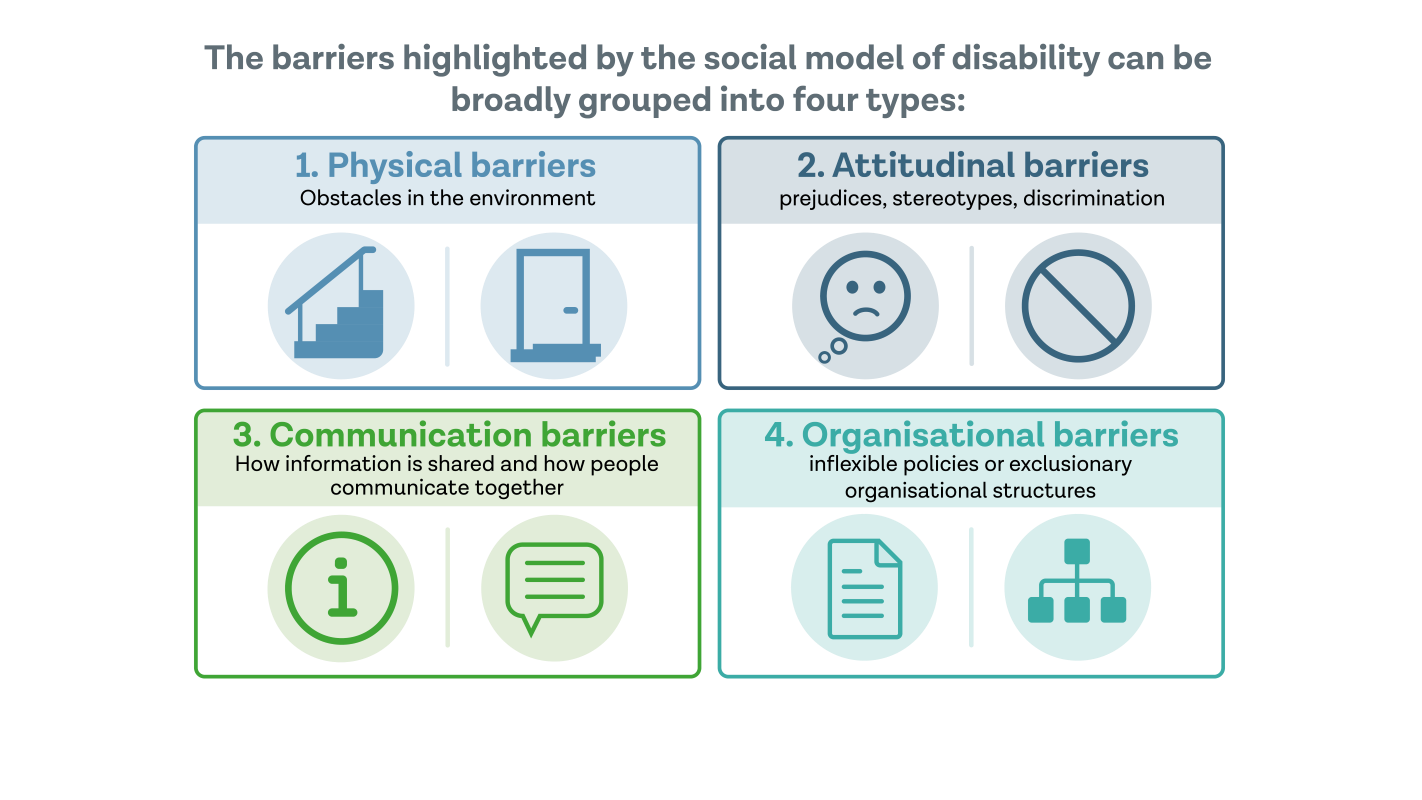
Although the model originated with physically disabled people, it can be used in all sorts of other situations; for instance, these barriers can affect people with mental health difficulties, neurodivergence or learning disabilities; they can affect how carers are viewed or treated, too. These barriers can also interact with other discriminatory attitudes in society like racism, ageism, and homophobia.
Reflection point
Think about each of these barriers in society and share your own example for each of them. This is a particularly important reflection for people with lived experience and people with a professional viewpoint to do together.
Just as in wider society, co-production projects can involve barriers to people’s participation. Consider this statement:
You don't want people to be afraid to say things because they worry that their support is going to be affected if it's with a local authority, or that they're going to be badged as a troublemaker.
This is an example of organisational and attitudinal barriers in co-production.
If the project is not a safe space for people to share their experiences, without worry about the consequences on their lives or about how they might be stereotyped, then it cannot be considered as co-production.
Another example which includes includes physical, attitudinal and organisational barriers, is shared in this podcast with Anna Severwright.
You know, the amount of times I have to say to people, “I can't be in central London at 9:00am. That is just not going to happen as a disabled person.” And then I have to often repeat that over and over again because they just forget because the world is set up that we're all working nine to five, and fit and healthy.

The mark of co-production
A digital tool to help anyone interested in planning, running, or evaluating a co-production project.