
Planning
Part of The mark of co-production. Select the quick links below to explore the key sections of this page.
Introduction
Planning a co-production project isn’t only about planning the project itself – although this is obviously very important. It includes thinking about what co-production means to everyone involved, being realistic about what’s achievable, and co-creating goals right from the outset.
It’s the time when expectations are set and processes are made clear – such as payments, frequency of meetings, and how the co-produced work will be used.
Is it not better to ask first? Let the people suggest what is needed. Pre-produce instead of co-produce. Work with the people before the idea comes to life.
Iggy Patel’s concept of preproduction is important here. Put simply, pre-production means that everything should be co-produced from the very beginning, including the topics to look at and how the practicalities of the project will work.
For each mark of co-production, consider together:
-
What does this mean for our project?
-
What ladders do we have?
-
What snakes might lay in wait for us?
-
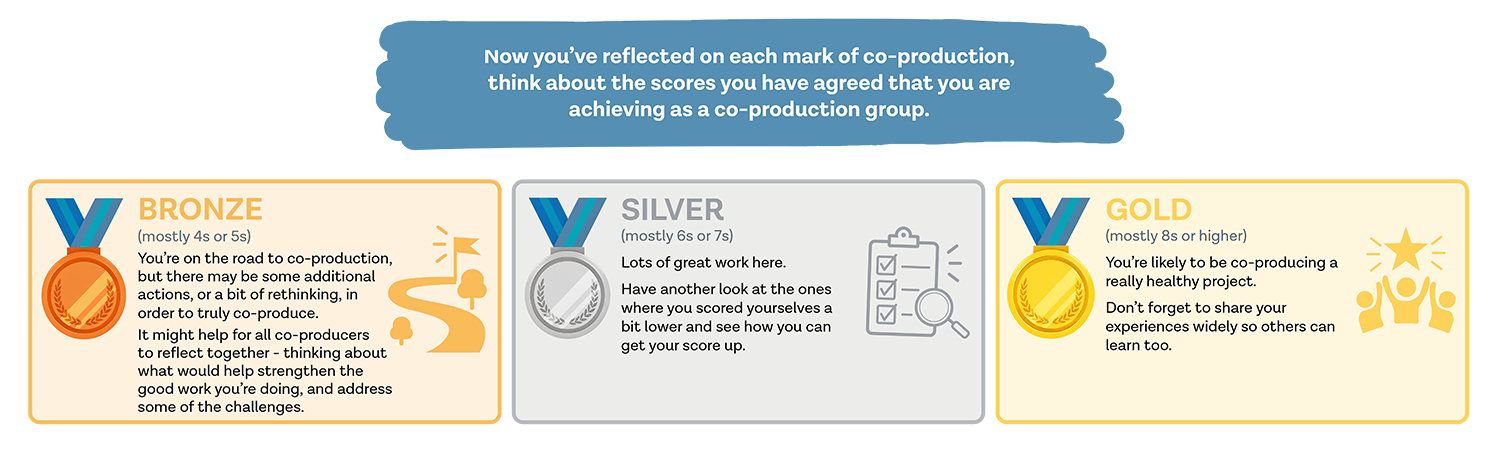
How far are we currently achieving this? (You might find it helpful for all co-producers to agree a score between 1 and 10 – 10 being the highest achievement – and you can then reflect on these scores at the end).
Then, add any additional marks of your own.
Don’t miss looking at the Lake of ideas - what ideas might be relevant at other stages of your co-production project?
Marks of co-production
Starting positively: bringing together co-producers
This is an exciting part of starting the co-production project! There are a few things to consider here:
-
Initial conversations. There may be benefit in having individual conversations before a bigger group meeting. This means people have the chance to ask questions in a one-to-one environment, which they might not feel comfortable doing in a bigger group with people they’ve only just met. It also helps settle practical issues (payment, meeting preferences, etc.) so this doesn’t take time away from main group discussion.
-
A diverse and enthusiastic group of people (this is true whether from a lived experience or professional background). It’s important to reach people who are not experienced in co-production and to explicitly consider ideas of equity, inclusion and diversity. This will ensure your co-production project is representative – and hopefully result in lively conversations!
-
The size. Big groups can bring more ideas, but they can also mean fewer people feel confident in speaking up. Smaller groups can feel safer and offer a deeper dive into the issues, but they can also risk losing wider perspective. What’s the right size for your project?
 We had one-to-one meetings in the couple of months before the project started. This was brilliant because we could build our knowledge about the project before being thrown into big group meetings.
Simply putting out a call for co-producers and expecting a magic mix of experiences isn’t realistic.
This is especially true when thinking about people traditionally underrepresented in co-production, for instance people: who identify as LGBTQ+, people from gypsy and traveller communities, and younger people. Intersectionality is also very important to think about. This is where people face multiple barriers simultaneously and may mean it is more challenging for them to be involved in a co-production project.
Thanks to Isaac Samuels for the two following examples.
There are a number of questions you might ask yourselves at the start of – and throughout – a project:
-
Who’s missing and why?
-
Are we thinking in an intersectional way, and aware that people may face multiple barriers to participation?
-
Who has to work hardest to participate?
-
Are we paying and scheduling our work in ways that exclude people?
-
Who gets believed fastest?
 Just recruiting people isn’t enough. The thread of inclusion needs to run through everything. As co-producers, everyone needs to put the work in, seeking ongoing feedback on how included everyone feels. Otherwise, people drop out, and what happens is people get labelled as 'hard to engage'. That’s not hard to engage, it’s a project that’s hard to access.
The Co-Production Collective’s 2025 Understanding Anti-Racism in Co-Production Spaces and The British Science Association’s 2025 Charter for Anti-Racist Co-production support projects in setting up co-production groups that are representative of communities, not tokenistic, and which challenge racism on an ongoing basis.
Develop your focus together
When a co-production project begins, it’s important that the focus is not already set. Having a general theme is very helpful, but co-producers from a professional or research background should not set a definite focus before collaborating with their co-producers from a lived experience perspective.
You can go completely down the wrong path if the focus is too tight. Then it’s harder to pull it back.
 My favourite part of our group’s agreement was ‘we are allowed to swear because these are issues we feel passionate about’. Those swears were all minuted!
 It’s always helpful to clarify the basis on which everyone is contributing. Are they representing themselves, or are they the views of an organisation? Deciding this at the start can really help prevent confusion later on.
 Some people can tie themselves up in knots about terms of reference and what this means. But we do need to know that ground rules are being followed.
Decide together who needs to be consulted or informed
For any number of reasons, some people who will be affected by the co-production project might not be able, or want, to be a co-producer. That doesn’t mean their voices aren’t important! Think creatively about how they can be kept abreast of the project – outreach work, regular updates, asking their opinions at key points.
Equally so, there may be organisational layers the co-production project will need to go through, for instance for approval. It’s important to establish any expectations related to this at the beginning, so all co-producers are aware of how their work will be presented and used.
While this may seem most relevant to professional or research co-producers, it’s important that there is transparency throughout about the funding. Who pays for what?
How does this affect deadlines and expenses throughout the project, and the expected outcomes that funders wish to see?
When you put your bid in for funding, consider what it can be used for. Is there a chance that co-producers can go on a training course, for instance to learn some skills about research? Do you need to put more money into developing co-production as a general way of working, or is everybody a confident co-producer? Is there money for dissemination events?
Together, co-producers can all discuss these issues so everyone can work with the opportunities and constraints funding can bring. Discuss openly what is, and what is not, possible as a co-production group.
Decide together where the co-producers will meet
How do we make this as accessible as possible for everyone? Will it be in person, online, or a mixture of both? Physical and communication needs are obviously fundamental to accessibility, but accessibility is about so much more. Think about, for example, how neurodivergent people might need a quiet room, or how a separate space for prayers may be needed. Ensure all needs are identified and addressed in a way that doesn’t make people feel self-conscious.
 Our project was nationwide, including co-producers living in Scotland and Northern Ireland, so this decision was easy for us – we would all meet online. But there was still a conversation about which platform to use, Zoom or Teams. In one of our groups, we made a definite decision to use Teams because one of the co-producers communicated mainly through chat, and this was the platform he was most familiar and comfortable with. Even though people think of Zoom and Teams as interchangeable, for him they definitely weren’t.
Not everyone has access to high-speed broadband or things like a laptop or printer. Can the project pay for a higher data allowance, for example? Can people meet on WhatsApp, which might be more accessible? Post things out, instead of sharing large files by email? All these things may seem minor but they can make a big difference to people feeling part of a project.
I’ve got a nut, chilli and bell pepper allergy. The meeting was near a kitchen where there’s lots of spicy food. They said, ‘well, you could wear a medical grade mask.' To me, that isn’t accessible because that’s making me stand out.
Identifying skills, roles and responsibilities (and avoiding assumptions)
Just because somebody comes from a professional perspective in this project does not necessarily mean they ‘naturally’ take responsibility for activities such as chairing meetings or facilitating focus groups. An open discussion on who would like to do these tasks – and whether they would like support to build their skills in this area – is important at the planning stage.
She met with everyone individually before the project started. She asked everyone what they needed and what their experiences were.
 People with lived experience were thrown in to being expected to facilitate meetings without time to prepare nor having the confidence to do that. That’s not sharing power, it’s back to ‘doing to’, not ‘doing with’.
Professional co-producers’ knowledge of policies (such as an organisation’s strategy or vision) can be invaluable when it comes to getting and sustaining support or resources for co-production. If you have this intel, don’t be afraid to volunteer it - it can really help the project succeed!
Setting out payment clearly
Most co-production projects will pay people with lived experience for their work, alongside any expenses incurred. This respects the principle that people’s time and expertise is valuable and worth paying for – after all, this is taken as a given with professional co-producers. Being clear how much people will be paid, when payment will occur (and whether people will have to invoice), and signposting on how this may affect benefits are all important steps to take.
In some cases, people with lived experience may be willing to co-produce without payment. They may consider other value that they get from it. But never assume that people will be happy to co-produce on a voluntary basis.
As always in co-production, it’s about honesty and communication. Consider this: if there is no payment on offer, who will you exclude from co-producing?
I’ve got skills in writing and reviewing technical documents. In one project, the researchers were really stretched. I said, 'let me type these up, and I’ll send it to you, and you can fine tune it'. They paid me £25 for my hour of work. It’s saying that although we’re an available resource, we’re not a cheap or free resource. Our time is valuable.
Building support and enthusiasm early on
It is hard to co-produce in a vacuum. For professional co-producers, this tends to relate to building support within an organisation, and getting leadership support to devote time and resources to it. Lived experience co-producers will often have a network, too; peers and professionals from previous co-production projects, for example.
Co-production can be seen as a risky project for organisations to undertake, because it involves letting go of control. But they should flip that, and think about how risky it is not to co-produce! They’ll keep on doing the same things and getting the same results without it.
In order to achieve something (the ‘product’ in co-production) things need to get done. But co-production can be unpredictable, because sometimes the project will take you to different places. This can sometimes clash with organisational or funding demands for deadlines and clearly set-out milestones. Make sure you balance these factors in a realistic timeframe, discussed with all members of the group (and not imposed by those from a professional perspective).
We had quite a generous timeline. And we needed all of it! Having something to structure us and propel us on was important, but it also left enough time for ideas to develop and for the group to explore.
Many co-producers, whether from lived experience or professional perspectives, are very knowledgeable about the co-production process. There is a wealth of experience on what works, the challenges that co-production can face, and this can be very useful to a project at its outset.
In an ideal world, there would be loads of information available about making the experience of co-production a success - but this isn’t always the case. Think of co-producers themselves as this resource!

The mark of co-production
A digital tool to help anyone interested in planning, running, or evaluating a co-production project.