
Using this tool
Part of The mark of co-production. Select the quick links below to explore the key sections of this page.
The tool
This tool is called 'The mark of co-production' because it aims to help everybody create a co-production benchmark for their own project. Through sharing our experiences, drawing on the research and encouraging you to reflect together as co-producers, we want to encourage everyone to co-produce as much as possible.
Each of the key areas, Planning; Process; Completing, sharing, celebrating; Review, represents a stage in co-production. In each, there are a number of marks of co-production alongside tips and examples. We suggest all co-producers reflect on each section together.
Throughout this resource we use the idea of snakes-and-ladders, like in the familiar board game, to guide you through your journey of co-production. All the examples we share, whether snake, ladder, or observation, come from real-life experiences.
 Snakes represent common misunderstandings or actions that can undermine co-production and set progress back.
 Ladders represent approaches and behaviours that help you move forward and strengthen co-production.
Everyone can discuss opinions and experiences, sharing ‘snakes’ and ‘ladders’ of their own as they go. We also encourage you to think about how far you have achieved, or are achieving, each mark of co-production, giving yourselves a score. This will help you identify areas to improve and identify areas of fantastic practice that you can share widely!
The lake of ideas
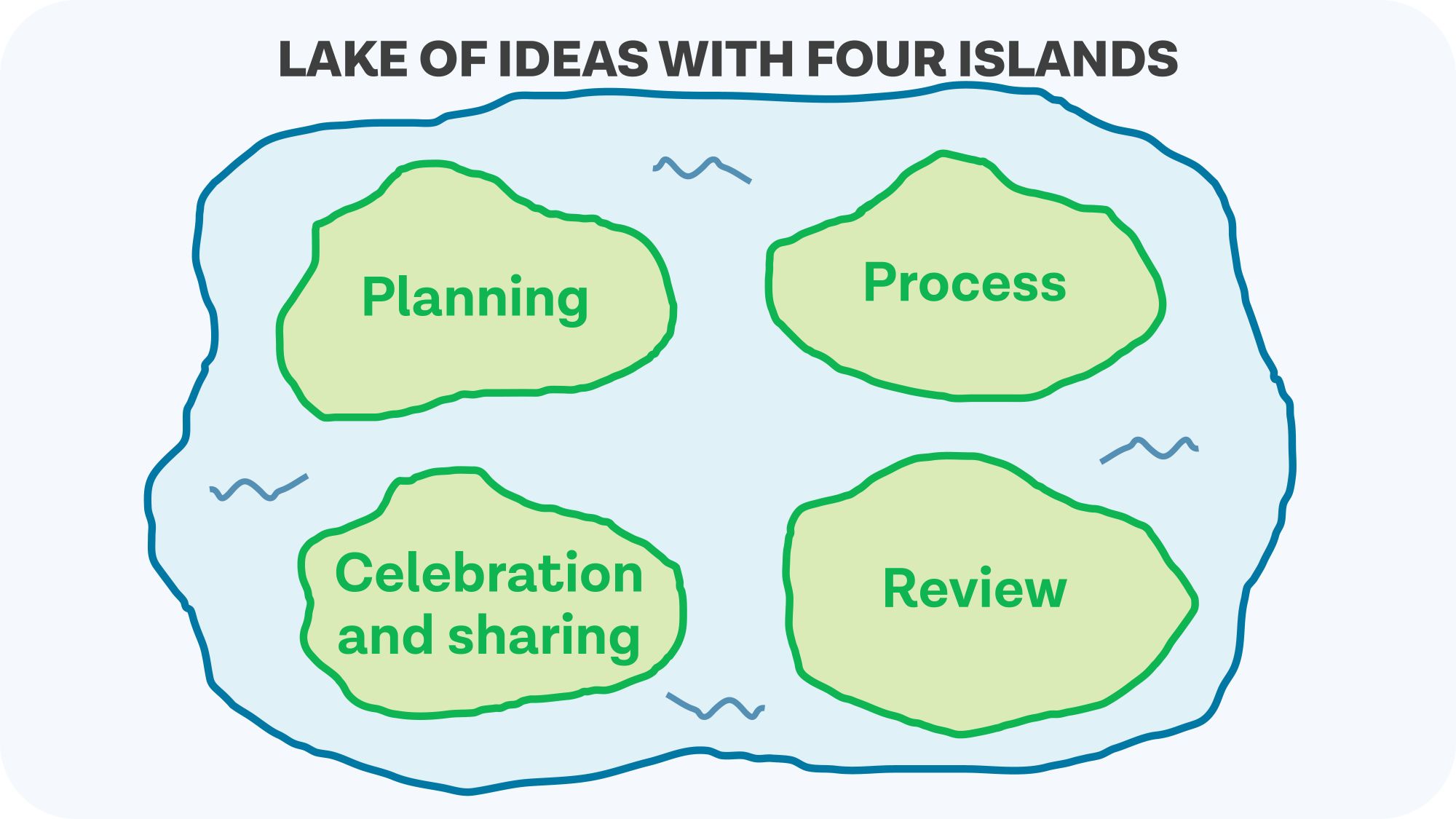
Although this tool is organised into different stages, it’s really important to not get too caught up in a set order in which things ‘should’ happen in co-production.
There isn’t always a clear distinction between different stages. Equally so, there will be principles that run through each section (such as the social model of disability). And while individual projects may end, co-production in itself should be an ongoing process supported by a foundational ethos rather than something that finishes when a project does.
This is the nature of co-production – co-producers need to remain flexible, open-minded, and willing to revisit plans when situations change. It’s a dynamic and often very exciting process.
It might be helpful to think about each section of this practice tool as islands in a huge lake swimming with ideas. They might not rest just on one particular island! Or, they might start on one, and then swim to another one. The power of the water might even try to push or pull you in another direction. The lake of ideas is a good reminder to ourselves to keep ideas fluid.
A good example of the lake of ideas is how ‘completing’ and ‘planning’ co-production are very much linked (even though the ‘process’ seems to come between them). You might plan, in the budget, for an event to share the results of your co-production project. And when the completion stage comes around, you’ll have learned a lot, and this will help planning new co-production projects.
Let's map ideas
All the co-producers to get round a table with a big piece of flip-chart paper or (if online) a piece of accessible software where everyone can contribute. Draw the four stages as ‘islands’. Use real or virtual post-it notes to note which ideas might swim between islands.

You might then want to spend five minutes with the lake at every meeting, adding and changing the lake of ideas as new things come to the co-producers.
- Make sure all co-producers are part of the pre-production, planning and shaping the project (it’s not co-production if all the aims have been decided before lived experience co-producers have joined the project).
- Be proactive in seeking out a diverse group of people to be co-producers. This doesn’t often happen naturally – it needs your efforts. The project should go where people are rather than expecting people to find the project.
- Decide together the co-production group’s ground rules.
- Everyone needs to pay attention to issues of power and equity right from the start. This will help identify and address unhelpful power dynamics early on.
- Where and when the co-producers will meet needs to be decided together. If it’s face-to-face meetings, transport and accessibility are key considerations. If it’s online, make sure everyone is comfortable with how these meetings will work. Are they digitally inclusive? Does everyone have internet access and the right technology to attend, or do they need support?
- Offer choice in how people can contribute, for example would people prefer one to one conversations or to write down their ideas and send them to the group?
- Don’t assume what people can (or can’t) do! Ask, and make sure there’s space for all to explore developing new skills and knowledge during the project.
- Set out payment clearly, including paying expenses.
- Establish any expectations related to organisational or quality assurance processes, so all co-producers are aware of how their work will be presented and used.
- Be realistic and flexible with timelines – they might well change…
The full section covers all this (and more) in detail, see Planning
-
Listening is everyone’s number one skill.
-
Don’t use jargon or acronyms (these often subtly convey who has power and who doesn’t) and think about your words carefully. Everyone needs to feel comfortable and respected.
-
Meetings don’t have to be all talking. What are some creative ways to unlock ideas?
-
Work together to create an atmosphere that’s as safe, open, and non-judgmental as possible. Topics in co-production can cause passionate debate; those overseeing the project need to ensure this doesn’t become conflict.
-
Respect diversity and practice Who is believed? Who is quiet? Who may be uncomfortable?
-
Secure and value admin support - this helps with invoicing, organisation, and lots of other practical tasks.
-
Develop contingencies – for instance, what happens if someone leaves the project?
-
Look after yourselves (and each other). People discuss real experiences and these can be distressing. Whether you are a professional or a lived experience co-producer, take some time to decompress after each meeting.
The full section covers all this (and more) in detail, see Process
-
Find the new beginnings in the end of every individual co-production project! What have you learned, what can you take forward, what can you share, what can you co-produce next?
-
Thank everybody and make sure that everyone (who wants to be) is kept updated on how the work is used.
-
Address together any tensions between a co-production ‘voice’ and an organisational ‘voice’ (for instance official style guides and design conventions).
-
Be inventive when you share the project’s work. Go outside established professional networks and share with communities, exploring the networks of the lived experience co-producers.
-
Celebrate - and co-produce this celebration, too. Make sure it’s something that’s inclusive for all.
-
Be honest about the challenges of the co-production project. You can be enthusiastic without being idealistic.
-
Reflect on your own experiences. What would you do differently? How has it changed how you think and act? What have you learned about co-production - and about yourself?
The full section covers all this (and more) in detail, see Completing, sharing, celebrating
-
Give yourselves credit! Co-production projects often aren’t reviewed at all.
-
Plan the review together from the start, and don’t leave it all to the end. Ongoing review and feedback are very important to co-production.
-
Make sure the review is as co-produced as the original project was. The review shouldn’t just be done by professionals.
-
Consider how you will review together. There might be an existing process or tool you can use, but make sure all co-producers (not just the professionals) agree it’s the best one to use.
-
Celebrate again. Think of the review as another chance to publicise the project!
-
Believe you are making a difference. Every co-production project contributes to a culture that normalises co-production as a way or working, equally valuing professional and lived experience voices.
The full section covers all this (and more) in detail, see Review
At a minimum, ask each other (and yourselves) throughout…
-
Are all co-producers (if they wish to be) part of planning and decision-making as well as sharing their experiences?
-
Whose voices are loudest? Are any voices missing? How do we address this?
-
Are we paying people, scheduling meetings, and conducting the project in ways that exclude people?
-
Are we looking after ourselves and each other? Is there any extra support needed?
-
Are there areas where we need to change direction or adapt our methods?
-
How can we gather and use feedback as we go?
-
What’s changed six months after the project (and what hasn’t)?
-
How can we share, celebrate, and be part of normalising co-production as a way of working?

The mark of co-production
A digital tool to help anyone interested in planning, running, or evaluating a co-production project.