
Process
Part of The mark of co-production. Select the quick links below to explore the key sections of this page.
Introduction
Once planning has taken place, the co-production project can truly begin. This will involve everyone working together to achieve the project’s aims, sharing experiences and ideas – and then shaping all the raw material together into something workable.
For each mark of co-production, consider together:
-
What does this mean for our project?
-
What ladders do we have?
-
What snakes might lay in wait for us?
-
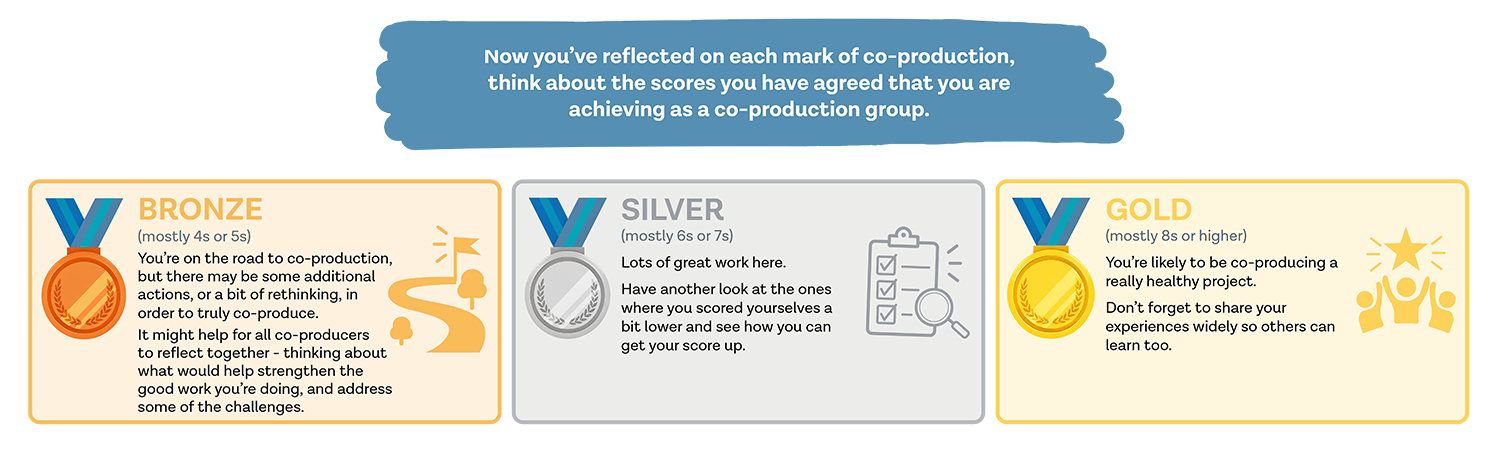
How far are we currently achieving this? (You might find it helpful for all co-producers to agree a score between 1 and 10 – you can then reflect on these scores at the end).
Then, add in any other marks of your own.
Don’t miss looking at the Lake of ideas - what ideas might be relevant at other stages of your co-production project?
Everyone has important things to share and to put into the mix. [Co-production is] coming together as equals, looking at different ways of solving problems, and then thinking how can we pick the main solutions that we need to put into place. And [then] coming up with innovative ways of doing that, that neither party would have thought of on their own.
Marks of co-production
Listening
This is the number one, top-of-everything important skill in co-production! And this is a skill that everyone can have, and that everyone can develop – it doesn’t require technical knowledge or professional qualifications. We’re all people. We have all experienced different things. It’s vital for everyone to listen to these experiences.
Gaining new skills
Personal and professional skills development might come up throughout the project. Professional co-producers should be prepared to ‘draw back the curtain’ and share process and knowledge. This in itself upskills people who don’t have this professional experience. Naming the skills people acquire or develop during a project can be really motivating.
 A willingness to learn in a safe space matters. I think we had four workshops at the beginning of the project, and they talked to us about open source software, GitHub, and ethics. This meant we could be more effective.
 Myself and others were in a team that helped design the website. Not just the information that went on it. But colours, fonts, layout too.
All co-producers need to understand the issues being talked about. Avoiding jargon and acronyms is very important. Everyone should be prepared to explain what they mean and answer questions.
I don’t like ‘stakeholders’. I always feel like they’re vampire slayers! Co-producers I think is good, as it’s inclusive to everybody. It embeds the philosophy that everybody is equal.
It’s also useful to think about words that may be in common usage and that everyone understands, but that may still feel uncomfortable.
The word ‘interview’ - it just makes me feel anxious already. It does feel quite formal. I think it’s better framed as a ‘conversation’.
They can be brilliant but they can also be excruciating! Make sure you’re not asking people to share something they might not feel comfortable with (this goes for professional co-producers and lived experience co-producers). Keep the power with the person. Also be mindful that they don’t take too long!
One icebreaker I like is asking for three words. They can be three words that make up a sentence or three individual words. No pressure with that one.
 There are moments when I haven’t been in a good place and I don’t want to open up that area at all. It’s about keeping it neutral, or giving people the option not to participate in it.
If you’ve only got an hour-long meeting, is the first twenty minutes on an icebreaker really a good use of everyone’s time? It’s also unfair, because some people give chapter and verse, and other people keep it short.
This was a project about involving people with dementia. The researcher brought outlines of heads, art stuff, magazines. We spent time decorating our head (not our literal head!) with what dementia means to us. There were people in that group with dementia, and people who were carers, and the buzz that afternoon was incredible.
Found poetry is created by taking words and phrases from an existing text and reframing them. We looked for impactful words and phrases, then arranged them into a poem, with some adjustments and additions. Like a collage with words.
In some cases, co-producers will not get along – either personally or in terms of working together on the project. Sometimes, people’s intersectional experiences of oppression or discrimination can be triggered by group dynamics. Reflecting not only on how to address conflict, but why difficult dynamics have arisen in the first place – particularly if related to power, intersectionality or inclusion – is very important.
 Conflict basically disrupted the group for about a year. It went on for longer than it needed to. We should have tackled it much earlier. We didn’t because we didn’t have the appropriate skills to, and people’s natural tendency was to avoid conflict, or pretend it wasn’t there.
While those responsible for overseeing the project hold responsibility to ensure debate doesn’t become argument, and that respect is maintained, it’s really important to build up everyone’s confidence and skills in addressing conflict and/or difficult dynamics. This can also help co-producers in other areas of their lives.
Through co-production, I’ve now got the confidence to say when I don’t agree with someone. Those are skills I didn’t have when I was at work. It’s about being a constructive friend. And about not being afraid of somebody with a ‘doctor’ in their title – that’s very helpful when you’re advocating for yourself or someone you care for in your life.
It’s about actually spending time with communities. Say your project is about researching oral health, take along some toothbrushes to people you talk to. What would help the community? You need to be part of the community to do meaningful co-production. It’s not just observation.
Think about (and talk about) power
This can be expressed in many different ways. Commonly it is when professional perspectives are seen as more ‘important’ than lived experience, but unhelpful power dynamics can also develop between different members of the group. For instance, someone’s opinion can be dismissed because they are less experienced in co-production.
 Sometimes you start a session and people introduce themselves. The professional co-producers will tell you their job title. The lived experience co-producers will say something personal. So immediately there’s an imbalance. I’m never really interested in someone’s job title. I just want to know about them.
If you’re using name tags, just put people’s name on it. Otherwise some people will have job titles and some people won’t. That’s a subtle but important way of ensuring people’s experiences are viewed equally.
I’ve been in rooms where the ladder of co-production is talked about, but then the meeting still runs like a staff briefing. Co-production is not about inviting people into the room – it’s about changing the room.
(Thanks to Isaac Samuels for this example.)
What are we taking forward? What are we dropping? What might need to be done differently? What are our gaps (and how will we fill them)? Ongoing reviews will also include checking in to see how the co-production process is working. Do all co-producers feel heard and valued? Are there any issues around power, conflict or exclusion that need to be tackled?
The questions from the planning stage are really useful to revisit at each meeting.
A Global Majority-led Anti-Racism Working Group was set up, with racialised people* setting priorities and pace. The group slowed down, reflected together, and agreed what safety meant before moving forward. From that space came work on strategy, safety and shared learning. This was co-production as infrastructure, not just discussion.
(Thanks to Isaac Samuels for this example.)
*The term 'racialised people' originates in social science and critical race theory and refers to people who are socially perceived, categorised, and treated as belonging to particular racial groups through historical and structural processes, rather than on the basis of any biological difference.
Try to take some time to decompress after co-production meetings, and ideally have someone to talk to outside of the project. Those responsible for overseeing the project should set out how people will be supported, and what will happen if someone gets upset.
I’d completely underestimated the emotional impact the co-production project would have on me. I was hearing really distressing stuff. It’s vital that you have somewhere to process that outside of the group, otherwise you will be very affected.
Develop contingencies
The nature of co-production is that it can be unpredictable. Think about what happens if people need to leave, or take a pause from the project; those with professional experience may move job roles or change responsibilities. Will you look to replace anyone who leaves? Will you have a plan to recruit new people to take part in the project instead? Perhaps through contacts or organisations that you know? Or you could ask the group who they would recommend if they were no longer available.
Some recruitments I’ve been to, there’s a careful process at the start, which is good with the initial set-up of the group. But then when the project wanted to increase its diversity, or increase the numbers, the recruitment process felt more like a tick-box exercise. We never actually turned anyone down.
Co-production projects should be representative of the communities that they work within. However, the responsibility for knowledge about issues such as anti-racism does not only lay with members of communities directly affected. Everyone has a duty to be curious, and to be an ally, throughout the project.
You might notice that someone is interrupted or talked over more than other people. Allyship is noticing, and then challenging, situations like that.
It’s just not enough to not be anti-racist as an individual. You have to call out racism. It took me quite a while to have the courage to do that. But once you do, you carry on, because you think “I’m not going to tolerate that”.
Anti-racism asks people to stay with discomfort instead of rushing to reassurance. The 2025 report Understanding anti-racism in co-production spaces: Centring the voices of racialised individuals is built from over 30 lived experience stories, and helps all co-producers create anti-racist spaces.
One of the things that comes up is cameras on, or cameras off. For me, if I’m in a group with somebody, and I’m sharing my very personal experience, I want to see them at least once. This comfort matters as much as people who want their own cameras off for their comfort.
Secure and value admin support
Don’t underestimate how much admin there is in co-production! From gathering times when everyone is available, to processing payment, to booking venues, this is a big part of making sure the project runs smoothly. Ideally someone should be responsible for this – someone with admin skills and patience. Don’t forget to value everyones contribution to the project - never take admin support for granted.
I was lucky with the project I was on, there were two admin people who worked closely together. They were particularly helpful in supporting people with invoicing. Someone had never written an invoice before, so they helped him with that and that was invaluable. I often think admin is like housework, no-one notices it when it’s done well but they absolutely do notice when it’s not done.

The mark of co-production
A digital tool to help anyone interested in planning, running, or evaluating a co-production project.