
Review
Part of The mark of co-production. Select the quick links below to explore the key sections of this page.
Introduction
Nothing in co-production is static! While your co-production project might have achieved all or some of its aims at its immediate end, what happens six months, a year, five years down the line? The circumstances may well have changed, or new challenges and opportunities could have emerged.
The authors of this tool agreed that, in their experience, reviews of co-production projects were limited (if they existed at all), and rarely involved people with lived experience. This is definitely an area that can be given more attention when co-producing.
A review will highlight not only whether the specific aims of the project have been met, but also how the co-production process worked as a whole - with important lessons for future co-production projects.
It also sends a strong message about the importance of co-production projects. Policies, frameworks, official documents - they usually have a date for review attached to them. It’s important to treat co-production with the same seriousness.
At the other end of the co-production process, it’s important to review and evaluate what emerges alongside the people involved in the project. […] The outcomes that will be measured, and how this will be done, is also a question for the whole co-production group rather than something decided on by professionals.
For each mark of co-production, consider together:
-
What does this mean for our project?
-
What ladders do we have?
-
What snakes might lay in wait for us?
-
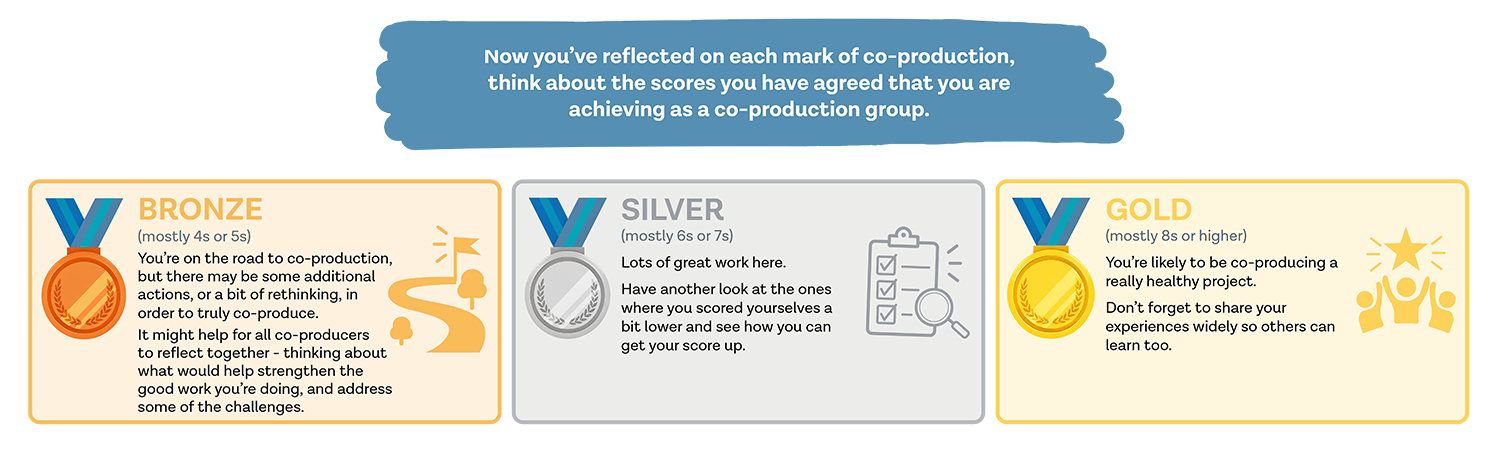
How far are we currently achieving this? (You might find it helpful for all co-producers to agree a score between 1 and 10 – you can then reflect on these scores at the end).
Then, add in any other marks of your own.
Don’t miss looking at the Lake of ideas - what ideas might be relevant at other stages of your co-production project?
Marks of co-production
Plan in the review from the very beginning
A review that’s part of the original timeline is much more likely to happen.
Review in stages - don’t leave it all to the end
This kind of iterative learning allows real-time action to happen, and changes to be made as the project goes along.
 At the end of each meeting we would capture some points, and then review these at the opening of the next meeting. Then you’re always keeping it relevant, and if there’s something coming up that didn’t work you can address it there and then.
Consider using a recognised evaluation tool - but make sure all co-producers are involved in deciding the best one
Even if co-producers from a professional perspective are familiar with evaluation and review tools, this shouldn’t mean that they are the ones who decide on the one to use. Professionals should use this knowledge instead to give lived experience co-producers the information they need to help decide on the most appropriate.
There are a number of tools out there for public impact assessment. We tried on one project, all of us, to agree which tool to use. For researchers, these tools are their bread-and-butter, and they helped by presenting different tools to the group.
Don’t just stick with one method for feedback
Make sure everyone feels safe in giving their feedback. Some people like a written form they can fill in in their own time. Others will prefer to give feedback face-to-face, over the phone, through a personal email or via a virtual meeting. Some people are happy to be frank; others will worry about sharing negative feedback. Consider the dynamics of the group carefully and always present people with a range of options - including lived experience co-producers feeding back to their peers - that will empower people to review their own experiences.
Haven’t we all done that? Where it’s some training event and it was rubbish, and we don’t bother to feed back. But that’s pointless for all concerned. Keep a written survey if you must but make sure there are other ways, too, so all viewpoints can be captured.
Prove to people that you’re going to do something with the feedback they’ve given you. There’s no point just giving out a form and then silence, because people will just get pissed off with you. That’s not even specific to co-production – it’s just general good practice in evaluation!
In essence, when reviewing co-production as a process, think about these questions:
- What went well?
- What could be better?
- What are your ideas for the future?
- Is there anything else you want to feedback?
These are four questions that everyone can understand and contribute too.
The last one in particular also respects and encourages everyone’s creative thinking.
 I remember a feedback form, an online one with a QR code so you had to keep clicking through different pages. There were 19 pages with different questions on each of them. How do you expect to get insightful comments if people have to wade through all that?
 The Co-Production Collective’s 2025 Understanding Anti-Racism in Co-Production Spaces and The British Science Association’s 2025 Charter for Anti-Racist Co-production both offer principles, recommendations, and actions to take to address racism and spot tokenism in co-production.
It’s good to think about your language here. People sometimes talk about getting ‘hard-to-reach’ groups in co-production. They’re not ‘hard-to-reach’ if you go the right way about it. Maybe use under-served, or under-represented instead.
Learn from both successes and mistakes - and co-produce what these look like
Successes and mistakes might look different from professional and lived experience perspectives, or have different weight attached to them. For instance, publishing journal articles might be more valued by academic co-producers than lived experience co-producers. Make sure everyone is part of determining what the review deems to have worked (or not worked).
 Actively seek out the warts-and-all perspective. That’s how you learn!
 Success for whom? Make sure everyone’s involved in what success looks like - this is definitely something that can be discussed during the project and not just at the end.
Look at the impact of technology on the co-production process
Most co-production projects use technology in some ways - whether that’s meeting online via Teams or Zoom, using online tools to gather reflections and feedback, or instruments such as polls to find out co-producers’ availability. What was their impact?
 A tech accessibility issue came up for us. We used an online tool (Canva) but this was not accessible to a member of the group who used BSL interpreters, nor to another member who was visually impaired. We all agreed that we had made an assumption without delving deeper into the implications of using the tool and it was a big learning point for us.
When we were creating this very resource, we wrote it together by talking through all of the points in Teams meetings. We auto-transcribed the meetings so, when it came to putting it together, we could ensure that our voices came through crystal clear in the final product.
Think of the review as another chance to celebrate and publicise the project! A review, whatever it turns up, will offer more avenues for sharing the work. Since reviews of co-production projects are rare, this is valuable knowledge that others will be interested in.
People often see reviews as opportunities for learning, which they are, but they’re not only that. If it’s still relevant and it’s gone well, celebrate that too!
Do something with your review
A review shouldn’t just be there for its own sake. What are the action points arising from it? The review is definitely a place where you can consider the Lake of ideas and how the things you found out can feed into future projects.
Note down your actions from the review, put a time limit on them, and put in a date to review them too!
Always share the findings of the review with all the original co-producers, and keep them informed of any actions arising from it.
Believe that you are making a difference
Culture change towards co-production can take a long time. Co-producers, whether from professional or lived experience perspectives, can be very used to how everything has always been. Yet, every time a co-production project is shared, celebrated and reviewed it all helps change that culture.
I think we’re seeing real change. I met this morning with a young person who’s just starting her PhD. She’s secured some funding for Patient and Public Involvement (PPI) training and is attending conferences and events. Co-production is mainstream to her. I thought, 'you’re new at this and you’re already doing better than a lot of seasoned researchers!' As these early career researchers move through the system, we’ll see the culture change.

The mark of co-production
A digital tool to help anyone interested in planning, running, or evaluating a co-production project.