
Eight information use practices
Part of a toolkit for the ethical and effective use of children's information. Select the quick links below to explore the key sections of this page.
Introduction
In this section, we explore the eight information use practices in the toolkit for ethical and effective use of children's information. The framework is organised into three structural layers, practices are an essential layer, together with core approaches and system enablers.
The practices
- Define how information can be more ethical and effective. For example, through operational methods and workflows.
- Help organisations prepare to use information.
- Show how to improve information use for better decision-making.
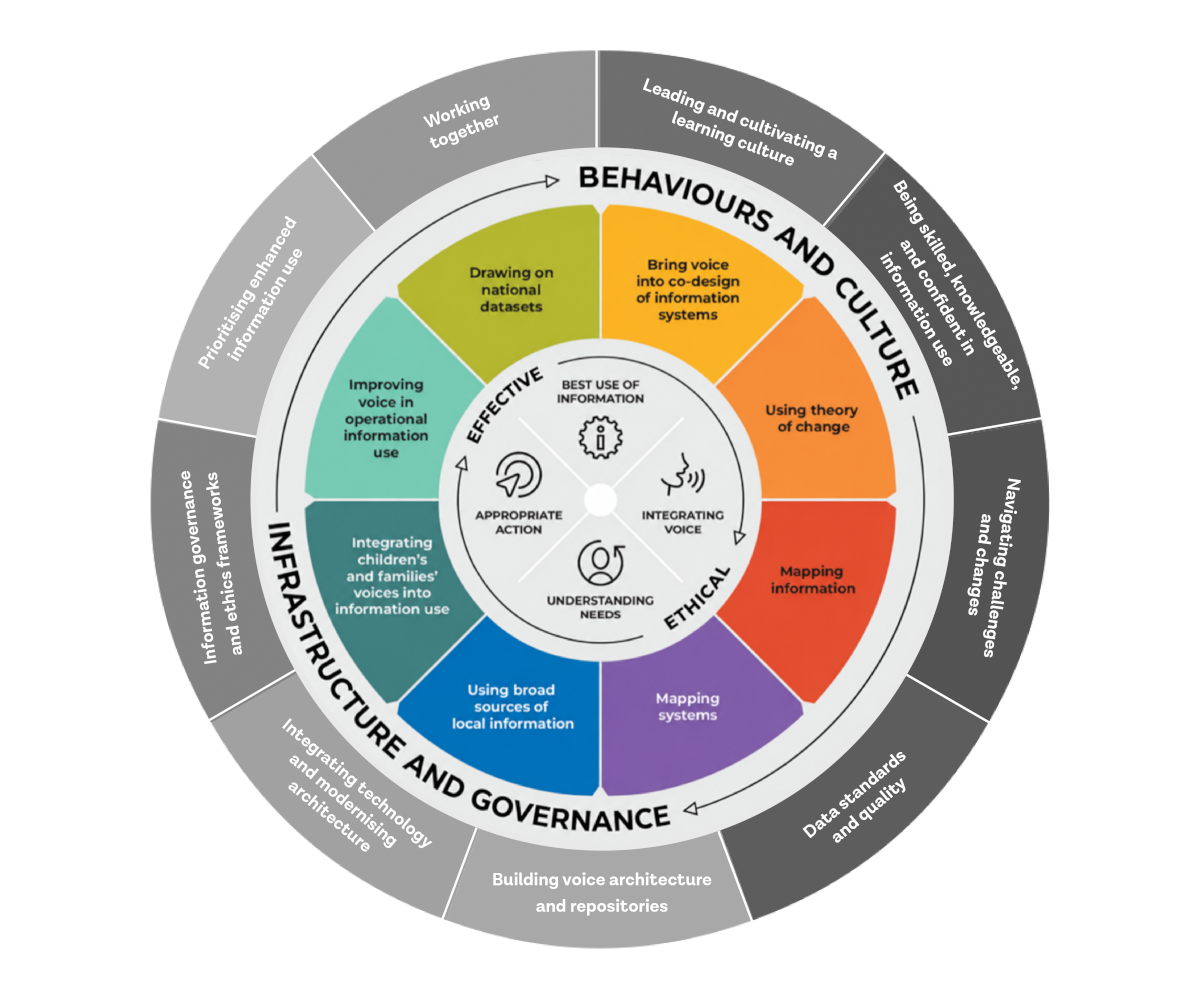
Structural core and layers of the framework.
Eight information use practices
-
Bringing voice into co-design: Using real-life experiences in designing information practices helps make sure that systems meet the needs of children and families.
-
Using a theory of change: This helps organisations think carefully about how they collect and use information. It directly links daily information use to outcomes.
-
Mapping information: Understanding the existing information landscape is fundamental to improving information use. Mapping information pathways shows what information is and is not available.
-
Mapping systems: Mapping the broader system gives a clear view of how local priorities, workforce roles, and service boundaries connect. It shows how information flows and where it gets stuck.
-
Using broad sources of information: Helps organisations better understand children and families. It includes a range of perspectives to improve outcomes.
-
Integrating children’s and families’ voices into aggregate and strategic information use: Lived experience helps keep service design and planning focused on the real needs of users. This helps improve outcomes and the experience of service.
-
Improving voice in operational information use: Ensuring voice is central to decisions helps keep relational practice at the heart of service delivery.
-
Drawing on national datasets: Using national datasets alongside local data helps generate valuable insights to improve outcomes.
Alongside each practice below, you will find links to enablers that are connected to that practice point. Practice examples and tools are provided at the end of this key area.
Co-designing information use means actively involving children, families, and practitioners as equal partners to decide what information is collected, how it is interpreted, and how it shapes decisions. It goes beyond basic feedback. It’s where families and professionals work together to set priorities, plan, and make decisions from day one.
Local authorities can apply this practice through five actionable steps that interconnect with the wider framework:
-
Use information and system mapping to understand the current information system. Look at where the voice of children, marginalised families, and practitioners are filtered out or missing.
-
Actively address power dynamics to build relational trust. Create inclusive spaces where diverse voices are welcome and share power.
-
Demystify abstract data terms by using plain language. Build shared language across multi-agency partners, practitioners, and families.
-
Create feedback loops so participants can see how their input made a difference.
-
Connect design with outcomes that matter most to children and families.
It’s important to find a range of ways to help people participate. For example, Oldham created short explainer videos and flexible focus groups to help parents easily share their views. In-person events and technology can help with co-design. Including diverse voices across the entire project life-cycle keeps practice improvements meaningful.
Enablers
A Theory of Change (ToC) acts as a roadmap. It helps connect information use directly to the real-world outcomes a project aims to achieve. Using a ToC helps define the specific problem, desired outcomes, and exact steps needed to turn data into meaningful action. It brings people together to create a shared vision. When diverse voices are included, it keeps the vision focused on what makes the most difference to children and families.
There are some key principles for success:
-
Be flexible. A ToC is a living document that should adapt over time.
-
Plans do not need to be perfect to be useful. Sometimes a practical approach and steady progress is better than over-complicated design.
-
Record the logic behind the ideas. This helps when testing out solutions. It helps surface assumptions meaning others can adapt the framework for their own projects.
-
Be sure to be clear about what the system enablers and barriers are. These will impact whether the vision can be achieved and sustained.
A ToC transforms information from abstract data into a vision for real-world impact. By treating it as a flexible, living roadmap, a ToC can bring people together to achieve common goals. It helps keep family needs at the centre of planning, and makes steady, practical progress possible. Clearly mapping out assumptions, system enablers, and barriers helps to create the conditions to achieve and sustain a shared vision.
Enablers
Understanding the current information landscape is essential for making real, practical improvements. Mapping information shows what data is already available and what it is missing. Mapping helps keep information systems focused on what is most important for good outcomes. A mapping exercise will trace how information is gathered, sorted, analysed, used, and reviewed.
The key tasks for Information mapping include:
-
Sort big-picture cohort numbers used for long-term planning from detailed individual files used in daily care.
-
Trace how information flows between people and agencies and where it gets stuck. Think about what helps information flow (enablers) and what acts as a barrier.
-
Spot gaps and unheard voices. Knowing whose voice is missing and what information is underused and why is important learning.
A big challenge uncovered through information mapping is the tendency toward datafication. This is when rich information is filtered into simple data and statistics for organisational and statutory reporting. In this process, the experiences and voices of children and families can get lost. This often simplifies their complex lives into simple numbers for counting and comparisons.
Mapping information across the system also builds a picture of how each partner agency (such as health, education, social care, and police) understands and uses information. Because children and families interact with multiple services, mapping shows how information moves—or gets blocked—between different organisational cultures. Partner agencies often store valuable insights in isolated systems. Mapping shows where information silos are and where data-sharing agreements or technical links are missing. It helps show agencies use different terms and thresholds. It also helps uncover hidden insights from community organisations, health visitors, and voluntary services. Mapping reveals voice-rich information that can help improve the system.
When agencies see the entire network mapped out, they can move from simply exchanging records to co-designing more effective pathways and sharing responsibility for outcomes.
Enablers
While information mapping tracks what information exists and how it moves, system mapping shows who holds that information, where decisions happen, and how relationships shape the flow of support. It builds a picture of how a multi-agency network works together. It shows the relationships between the policy, processes, and people.
System mapping looks at:
-
How things fit together. Systems mapping connects leadership, reporting lines, and joint forums across health, education, early years, and social care.
-
Support across universal, targeted, and specialist services. Systems mapping shows how responsibilities shift as family needs grow.
-
Key frontline roles that bridge the gap between families, community groups, and official services.
System mapping reveals:
-
Bottlenecks and vulnerabilities, such as when a system relies too heavily on a single staff group.
-
Unclear pathways to support. Some pathways will appear well defined and easy navigate, while others are less clear.
-
Duplication and friction, such as multi-agency teams repeating work or where rules prevent services from collaborating.
System mapping goes beyond static organisational charts. It gives all partner agencies a single, shared reference point to clarify roles and responsibilities, fix workflows, and break down silos. These are important steps that lead to real-world collaboration.
Enablers
Over-reliance on national administrative datasets often leaves critical gaps in understanding local needs. Using a broader range of information helps organisations better understand children and families. This leads to a more holistic understanding of individual and local needs.
Using broad sources of local information means:
-
Looking beyond official reports. Use detailed case management, practitioner insights, and community feedback. Use technology to enhance how voice is gathered, stored, and used.
-
Reviewing existing tools, like operational dashboards, to make sure they help frontline decision-making. Aim for active support, not just passive reporting.
-
Gather information and insights from across service areas. This helps link daily practice with long-term strategic planning.
To use local information effectively, services must overcome three main hurdles.
-
Local data is often fragmented and locked inside separate software systems using incompatible formats
-
Overly cautious or inconsistent interpretations of privacy laws like GDPR create constant data-sharing friction between partner agencies.
-
Rigid compliance rules force teams to track narrow process targets instead of meaningful outcomes. For example, recording if a young person needs a placement move. Compared to whether they feel safe, stable, and supported.
Embracing diverse information sources calls for a cultural shift. It means valuing narratives just as much as numerical data. Shifting focus from basic compliance to insight-driven practice ensures that information systems reflect real human stories.
Enablers
Statutory reporting requirements rarely reflect the voices or lived experiences of children and families. It focuses heavily on performance metrics rather than what truly matters to families. There is a lot of valuable voice-informed information in case records and frontline interactions. Yet, it is rarely brought together into larger datasets for strategic planning.
Bridging this gap centres on three core principles:
- Combine numbers with stories. Treat performance metrics and voice as complementary tools instead of a separate choice.
- Analyse narratives across case records to see the bigger picture across the community.
- Match ambition with system readiness. This means designing a data project around what an organisation can realistically handle right now.
To turn voice-led goals into sustainable information practices, work flexibly. Focus on the organisation's culture, relationships, and readiness. Organisations start from different points. Focus on strengths and what is possible now.
Integrating lived experience into aggregate reporting ensures that strategic decision-making, policy creation, and resource allocation are grounded in authentic human needs. Making this work relies on building an organisational culture that values human stories alongside numbers.
Enablers
Operational information use focuses on day-to-day practice with children and families. Practitioners act as key narrators and advocates. They translate relational conversations into recorded information, sometimes with support from artificial intelligence (AI).
Embedding voice into daily practice centres these principles:
-
Frontline workers play an essential role in capturing voice through careful, respectful recording.
-
Balancing statutory metrics with rich narratives is key. Prioritise lived experience over compliance.
-
Recording should reflect open, two-way conversations rather than narrow, professional-led checklists.
-
Practitioners should engage families directly in discussions about what information is recorded, how it will be used, and what matters most to them.
While practitioners show commitment to relational listening, there are barriers. Recording templates, deadlines, and administrative rules often overshadow rich narratives. Statutory requirements prioritise performance metrics. This results in context-rich observations being lost. Also, assessment tools are weighted toward professional judgments rather than capturing voice.
Improving voice in daily operational practice is the foundation to ethical and effective information use. Listening to families—and acting on what they say—shares power and ensures support is driven by real lives rather than compliance targets.
Enablers
Statutory national reporting usually captures a small part of local information. It often leaves out the voices and real experiences of children and families. Linking national datasets with local information transforms routine reporting. It generates valuable insights that guide strategic planning and enhance individual outcomes.
To gain more value from data:
- Look beyond performance benchmarks to analyse individual journeys and long-term progress over time.
- Look at how local place-based factors shape child outcomes. For example, demographics, community resources, and service demand.
- Find where information gets lost. Sometimes valuable insights from frontline staff get lost in aggregated reporting.
Connecting information across education, health, and social care over time shows how families navigate services and where support works best. While national data highlight broad population trends, local systems provide the stories needed to understand why those trends happen and how to respond.
Unlocking the value of these datasets means working together to develop the infrastructure and governance to share information well. Combining national trends with local insights ensures information systems are ethical, transparent, and person-centred.
Enablers
Practice examples and tools
Practice examples
- Meaningful co-production in Durham.
-
North Yorkshire: Using better information to meet care leavers' needs.
-
Rochdale: Developing a theory of change for the early years.
-
Oldham: Co-designing and screening early years communication needs.
- Principles and values for data governance and ethics centring the voices of children and families: Video learning resources.
-
Practical approaches for families first and beyond: Webinar resources.
External resources
A toolkit for the ethical and effective use of children's information
Digital resources explore definitions, tools and examples for practitioners and data leads to strengthen children's information use.