
Life story work is included in almost every plan for a care-experienced child or young person. It can be used as a specific intervention or objective to help them understand their history, identity, relationships and experiences.
However, many practitioners report that they don’t know how to start this work and feel overwhelmed at the prospect of doing so. In Wirral, we set out to understand why. What we found changed how we train our staff and who we think the work belongs to.
What does the research tell us?
No national guidelines exist for life story work, so provision across England is often reported as fragmented and inconsistent. A scoping review found that while life story work is a clear priority for care-experienced young people and those supporting them, we still know very little about what works, for whom, or over what period. It has since been argued that the term covers such a wide range of different activities that the absence of a shared definition is itself a barrier to research, training and practice.
Within Wirral, I carried out practitioner research consisting of surveys and interviews that was presented at our Social Work Research Conference in December 2025. This found a recognisable cycle underlying the drift associated with life story work. Colleagues wanted to do this work well, but without an agreed method or a clear starting point the work often waited for a better moment that rarely came. That gave us something concrete to design against.
Innovation in life story work
In 2024, I completed the Frontline Innovation Programme, a unique opportunity which gives practitioners coaching, workshops and the chance to bid for funding to tackle a problem they have met first-hand. The result was a deck of 93 colour-coded, trauma-informed cards developed to help practitioners deliver life story work. Working with an artist meant that the cards could be carefully designed in a way that could present emotive experiences in a safe, contained way.
The sections of the cards move through relationship building, emotional literacy, emotional regulation, timeline work and difficult conversations. They are underpinned by Dan Hughes’ PACE principles: playfulness, acceptance, curiosity and empathy. The child or young person is empowered to control the pace of the sessions and practitioners have a sense of structure as they share a child’s journey with them. The use of imagery, metaphor and creative prompts allows children and young people to explore experiences at a safe emotional distance, in much the same way therapeutic stories can support reflection and understanding.
As part of an initial pilot, Wirral is rolling the cards out alongside a training programme open to any professional working directly with children and young people. Over 100 professionals have now been trained, ranging from social workers, early help workers, personal advisers, educational psychologists and more – which is the point, life story work is everybody’s business:
The cards have been a gamechanger for me delivering life story work.
Newly qualified social worker
Understanding life story work will help us work in a more trauma informed way with our families.
Early years worker
I will take a moment to reflect and record moments that a child will read in the future.
Social worker
I am now looking at things through a different lens – a life story approach when I am working with young people.
Educational psychologist
It is helpful to have a physical resource that I can use in practice with the young people I’m supporting.
Personal advisor
Co-production and changing the narrative
The most significant shift in Wirral is being led by Kerry Bull, Operational Lead for our Leaving Care Service. For National Care Leavers’ Month, we have launched an exciting campaign: Small Things, Big Impact. Co-produced with our care-experienced young people, it seeks to reframe life story work as something built continuously across a young person's journey rather than a single specialist task at the end of it - and as belonging to everyone around them.
A driving force behind the campaign is Kali Hughes, a care-experienced young person currently completing a business administration apprenticeship in the council. Kali is passionate about making a difference for other young people and ensuring their voices shape practice. Working alongside the Care Leavers Council, she has helped turn personal experiences and reflection into practical guidance for the adults who care for and work with children and young people.
That means family help and early help, assessment and intervention, permanence, independent reviewing officers, education, fostering, leaving care and beyond. Different roles and different responsibilities, all contributing to a young person's story in a way that lasts.
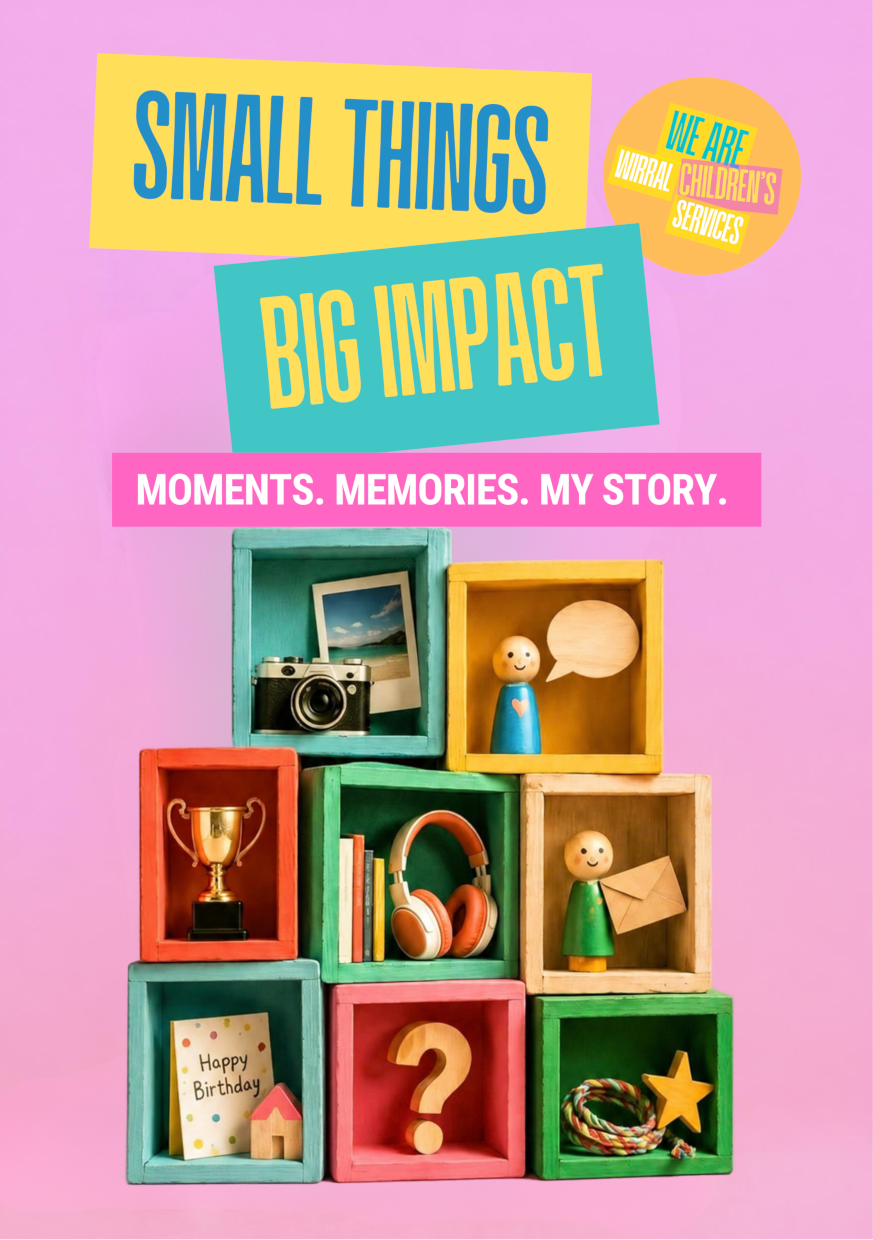
Poster for Wirral's Small Things, Big Impact campaign.
What our young people tell us
Kali has spoken about the difference it would have made to receive letters from the people who knew and cared about her when she was younger. For many children in care, there can be numerous adults involved in their lives over time, making it difficult to remember who someone was, how they supported them, and why they mattered. A letter, photograph, or memory captured in the moment may feel like a small act to a professional, but it can become a treasured part of a young person's story and identity for years to come.
Kali is also clear about the importance of helping children understand that coming into care is never their fault. These reflections sit at the heart of Small Things, Big Impact.
What our young people asked for, when reflecting on their own experiences, was not complicated. The things that became treasured parts of their story were rarely the formal pieces of work. They were the everyday ones: someone celebrating a success, a photograph saved, a letter written by a worker who was stepping away, a good day recorded rather than only an incident. They wanted their strengths and what they had overcome to be visible, not only what had happened to them.
It also tells us where this work sits. Life story work is not separate from direct work, it runs straight through it, through identity, self-esteem and relationship building. This aligns closely with the LIMITLESS project at the University of East Anglia that makes the case that life story work can be delivered in a lower-intensity way to adolescents through everyday, ongoing work by the adults already in a young person's life.
Project lead, Dr Simon P Hammond explores the use of a low-intensity approach to life story work to support positive self-narratives of young people in care and outline principles of impactful practice in a series of open access Research in Practice videos.
What's next?
For Wirral, this is just the starting point. The true measure of success will be the impact on our young people, which will need to be evaluated over time.
We are committed to keeping their voices at the centre of how this develops rather than consulting once and moving on and exploring how technology can make life story work more accessible and more genuinely theirs to hold.
Together, we will continue to promote this message: Life story work is everyone’s business – and it is the small things, done consistently, that make the biggest difference.
If you would like to find out more about the life story work cards, please get in touch via email.
- Golding, K.S. and Hughes, D.A. (2012) Creating Loving Attachments: Parenting with PACE to Nurture Confidence and Security in the Troubled Child. London: Jessica Kingsley Publishers.
- Hammond, S.P., Young, J. and Duddy, C. (2020) 'Life story work for children and young people with care experience: A scoping review', Developmental Child Welfare, 2(4), pp. 293–315.
- Hammond, S.P. et al. (2023) 'Improving the mental health and mental health support available to adolescents with social care-experience via low-intensity life story work: A realist review', BMJ Open, 13, e075093.
- Neal, L. and Matthews, K. (2025) 'What is life story work? How defining approaches can bring clarity to research, training and practice', British Journal of Social Work, 55(3), pp. 1041–1059.
- Baynes, P. (2022). Life Story Work: Practice Tool. Research in Practice.
- University of East Anglia, LIMITLESS: adolescent-focused low-intensity life story work.


Capturing ‘magic moments’: testing co-designed resources with kinship and foster carers
There is a need for evidence-based, accessible ways to support young people’s wellbeing and sense of identity. The LIMITLESS II project aims to understand if life story work could be delivered in a lower-intensity way to adolescents.

The Cards You’re Dealt: Amplifying the voices of young people with care experience
Young Voices Influencing Care is a group of passionate and resilient young people with care experience in Hull. The group has developed a new card game designed to help the adults who support them to see the care system through the eyes of a child.

Life Story Work: Practice Tool (2022)
This practice tool aims to build confidence in explaining difficult stories for care experienced children and young people.

Creative life story work: The Blue Cabin approach
These video clips provide an overview of Blue Cabin's creative life story approach to working with children, young people and their carers. The approach is based on Rose’s model of 'Therapeutic Life Story Work' and provides space for children and young people to make sense of their lives.

Using adolescent-focused low-intensity life story work: Video learning resources
These short videos explore the use of a low-intensity approach to life story work to support positive self-narratives of young people in care and outline principles of impactful practice.

Ensuring children's life stories are at the centre of direct work
Lizzie Hills, Practice Lead at Norfolk County Council, talks about Norfolk County Council’s approach to life story work and the importance of making sure that children’s life stories, and how they understand them, is at the centre of all direct work with them.